Last week was something of a slow news week for many of us in the Japanese media here in Washington. Monday was President's Day, so the federal government was closed, and Congress was in recess. The few newsworthy events of the week (President Bush traveling around the country to promote his health care and energy initiatives, the South Korean defense minister, Kim Jang-soo, visiting the Pentagon on Friday, and the war of words between the Clinton and Obama campaigns), didn't really concern us. The major U.S.-Japan event was Vice President Cheney's visit to Japan, but since Tokyo covers these events, we had nothing to do with it.
So instead of going into some kind of analysis of developments I didn't cover, I would like to take this opportunity to share with you the lighter side of a few press conferences and discussions I attended this past week.
On Tuesday (February 20), the National Press Club sponsored a discussion with White House Press Secretary Tony Snow and a few seasoned members of the White House Press Corps. Hosted by CBS chief Washington correspondent Bob Schieffer (who turns 70 today), the hour-long discussion shed some light on the personal lives and day-to-day job responsibilities of six White House correspondents (listed at the bottom of the page here). The format was a mostly friendly, reverse press briefing, where the press secretary asked members of the press about their lives and experiences covering the White House. While humorous anecdotes abounded, my favorite exchange came when Tony Snow asked David Gregory what it was like to go to his hometown and be recognized or celebrated for being a TV personality. It went something like this (these are not direct quotes):
Snow: "What's it like going back home and having people recognize you when you go out? I'm sure it's pretty awesome to be a hometown celebrity."
Gregory: "I don't think I get recognized enough! But I think the most memorable moment when I was recognized was one time when we were covering a convention in Nevada. I will never forget when this sweet older woman came up to me with the biggest smile on her face and a sweet voice, saying, 'You're that guy on TV! Wow, it's great to meet you! By the way, you are completely ridiculous. Why do you ask such silly questions at press conferences?' The woman then asked to take a picture with me."
I want to shake that woman's hand.
Mark Knoller, the CBS radio correspondent with a very distinctive voice put in his two cents on the subject shortly thereafter...
Knoller: "Tony, one of the good things about being on the radio is that nobody knows what I look like. It means I can go to Barnes and Noble and look at dirty magazines without having to worry about getting spotted."
For those of you who are curious, here's a link to an article on CBS's website with a picture of Mr. Knoller. Be on the lookout next time you're at a big bookstore.
Mr. Knoller was on a role this week. Now I haven't been attending White House press briefings or gaggles (sort of mini-briefings held off-camera most mornings), so he might be on a roll all the time, but I was a big fan of his joke in the gaggle on Friday. Deputy Press Secretary Tony Fratto was going over the schedule of the president for the following week. When he mentioned the president's photo-op with the Miami Heat on Tuesday the 27th, there was little discussion in the room. Mr. Fratto seemed like he was about to explain that it was a pro basketball team, when Mr. Knoller cut him off with: "They're a global warming group."
Maybe you had to be there, but we all thought it was funny.
Perhaps the best exchange last week was the one between Ambassador Christopher Hill (the U.S. representative to the six-party talks among the U.S., Japan, China, Russia, and North and South Korea) and a reporter from Fox News.
This was on Thursday (the 22nd) at the Brookings Institute. Brookings had a live satellite uplink with the Asia Society in New York, and to be fair to both audiences, was alternating questions between the two venues. Two questions from NY, two from DC, back to NY for 2, then back to DC for 2... Pretty easy, right? You'd think so.
After 2 from DC, the moderator was about to ask NY for two, but didn't have the chance to get started when a woman standing on the side of the room shouted out (again, no direct quotes):
"This is (name deleted) from Fox News and I have a question!"
She got to mid-question before she was cut off, but then the strangest thing happened. She left the room. She barely made it back in time to be the 2nd person to ask a question from DC. It went a little something like this:
"This is (name deleted) from Fox News and I have a question. Yes, so the IAEA came out with a report today outlining how the Iranian government has not complied with UN Security Council resolutions calling on it to halt uranium enrichment. All the evidence points to them continuing this enrichment. What do you think of this?"
Keep in mind that this discussion is 100% about the six party talks and the NORTH KOREAN nuclear problem. Not one to keep a speechless audience waiting, Ambassador Hill shot back with:
"I think you're in the wrong press conference. I field questions about the six party talks, North Korea, and the Boston Red Sox."
Well, the U.S. and North Korea will be holding a working group meeting sometime in the coming weeks in New York, which I will likely be following, so I will try to keep posting updates on the ambassador's snappy answers to stupid questions. Somehow I doubt this will be the last instance...
Sunday, February 25, 2007


Sunday, January 07, 2007
Just fooling around...
Well, I haven't worked on my blog in ages, but since I've been busy playing around with some new technology (namely, Google Earth), I've decided to see what kind of cool new stuff I can figure out. Google Earth hosts pictures posted by users of Panoramio, a photo-hosting site much like Flickr. I've opened an account there hoping that some of my photos will be viewable by Google Earth users. I think it takes a few weeks after you post before anyone can see them, so I've uploaded this Panoramio map that should show the locations of the pictures I've loaded to their site. I'm going to keep Flickr as my primary photo-sharing online album, but I'm thinking of using Panoramio as a sort of "best of" site, where I'll try to load a few pictures from places around the U.S. and around the world that I've been to that I feel are representative of the time I spent there. Since the map above shows the whole world, you have to zoom in on one location to see all the different pictures from that place. Florence, Italy, for example, has about six pictures currently loaded for it, but you won't see where they are unless you zoom in pretty close. I've done my best to get the locations where the pictures were taken as accurate as possible, but if you feel any are misplaced, please let me know.
I have also added geo-tags to most, if not all, of my flickr photos on that site. This is no small task, considering the 2,000+ pictures I have on there (I had a long winter vacation), which you can also explore using my flickr account by going to this site: http://www.flickr.com/photos/straderpayton/map/ but the problem with flickr is that it uses Yahoo maps, which are frequently are available at a lower resolution or with less information than google maps (which Panoramio uses). This is especially true for Japan. Google's maps of Japan are very detailed and have extremely high resolution satellite images for major metropolitan areas (unfortunately not so for smaller towns like Isesaki).
Anyway, please let me know if you have any questions, comments, or suggestions.
Wednesday, March 15, 2006
あ、そうだ!日本語能力試験(2級)を合格しました!
...which means: "Oh yeah, that's right! I passed the Japanese Language Proficiency Test (Level 2)!" That was my big news a couple of weeks ago. I was fairly confident, but I had some trouble with the reading/grammar section, so it was a relief to get my certification.
Just wanted to brag a little...
Just wanted to brag a little...
久しぶりですね! 好久不見!
Or “long time, no see”. I know I’ve been really bad about posting since I’ve gotten back to the States, but things are pretty hectic for me right now. This semester is going well, but I’m having a hard time remembering ever being busier. My classes aren’t too hard this semester, but I’m also teaching, working, and looking for and applying for jobs. Spring Break is coming up next week, but it’s going to be a working vacation for me. I’m going to Washington, D.C. to try to look for jobs, hang out with old friends, and get some schoolwork done in the midst of it all.
Looking for a job is the most tedious task I have to right now. I’m planning on moving out to D.C. after I graduate whether I’ve found a job by the end of the semester or not, but obviously it would be better to get hired before making the move. Unfortunately, most of the interesting jobs require more experience than I have and the jobs that I know I can get don’t interest me much. The competition for the interesting international affairs research positions that I’m going for is intense, but I have a feeling something will come along eventually…
I’m trying to do all the job searching I can in the next couple of weeks, because I doubt I’ll have much time for anything after Spring Break. Since we’ll be in the last half of the semester, I will be working full-steam on my research papers, work for professors, and getting the 101 class I’m teaching ready for their comprehensive final. April will be an unusually busy month for us in the political science department; we will have at least three separate conferences on campus. On April 1 and 2, we are hosting a conference about Taiwan’s relations with the outside world (see: “Taiwan and the World” for more information). I will be driving some of our guest speakers around that weekend, which should be fun, especially if I get some Taiwan independence advocates in the same car with the pro-PRC scholars.
On April 11, I’ll be helping Dr. Olimat with a conference he has organized about America’s relations with the Middle East (“America, Islam, and the Middle East”). And from April 19 to 21, Missouri State is hosting a Public Affairs Conference that is drawing in a lot of well-known speakers for panel discussions and plenary sessions on various topics (see “Public Affairs Conference” for more information). This is the second year of the conference and I missed it last year, so I’m hoping to see as many of the sessions this year as I can.
I apologize if my writing lacks lucidity today. My brother left for an English conference in Fort Lauderdale, FL this morning and I had to wake up at 4:30 to drive him to the airport. He was accepted to give a presentation on research he’s done on a genre of horror writing (the name of the genre escapes me at the moment) and he’s staying for the whole week. Although he’s going to arrive a little sleep-deprived, I think he’ll perk up when he gets there and can attend the panel session on zombies! (Sometimes I think I’ve chosen the wrong field…)
See ya!
Looking for a job is the most tedious task I have to right now. I’m planning on moving out to D.C. after I graduate whether I’ve found a job by the end of the semester or not, but obviously it would be better to get hired before making the move. Unfortunately, most of the interesting jobs require more experience than I have and the jobs that I know I can get don’t interest me much. The competition for the interesting international affairs research positions that I’m going for is intense, but I have a feeling something will come along eventually…
I’m trying to do all the job searching I can in the next couple of weeks, because I doubt I’ll have much time for anything after Spring Break. Since we’ll be in the last half of the semester, I will be working full-steam on my research papers, work for professors, and getting the 101 class I’m teaching ready for their comprehensive final. April will be an unusually busy month for us in the political science department; we will have at least three separate conferences on campus. On April 1 and 2, we are hosting a conference about Taiwan’s relations with the outside world (see: “Taiwan and the World” for more information). I will be driving some of our guest speakers around that weekend, which should be fun, especially if I get some Taiwan independence advocates in the same car with the pro-PRC scholars.
On April 11, I’ll be helping Dr. Olimat with a conference he has organized about America’s relations with the Middle East (“America, Islam, and the Middle East”). And from April 19 to 21, Missouri State is hosting a Public Affairs Conference that is drawing in a lot of well-known speakers for panel discussions and plenary sessions on various topics (see “Public Affairs Conference” for more information). This is the second year of the conference and I missed it last year, so I’m hoping to see as many of the sessions this year as I can.
I apologize if my writing lacks lucidity today. My brother left for an English conference in Fort Lauderdale, FL this morning and I had to wake up at 4:30 to drive him to the airport. He was accepted to give a presentation on research he’s done on a genre of horror writing (the name of the genre escapes me at the moment) and he’s staying for the whole week. Although he’s going to arrive a little sleep-deprived, I think he’ll perk up when he gets there and can attend the panel session on zombies! (Sometimes I think I’ve chosen the wrong field…)
See ya!
Thursday, January 19, 2006
I'm baaaaaack!!!!!
And it feels good to be back! Sorry for the long absence, but I’ve been taking some much-needed time off to relax and get reacquainted with American life. This has included lazy days of TV, video games, Papa John’s, shopping at Wal-Mart, and hanging out with friends and family. That was my pattern for about a week and a half after Christmas, but I did do some work during winter vacation. I finished my paper for my Cross-strait Relations in Asia-Pacific Security class on Taiwan-Japan relations and a job application for a fellowship position at the National Bureau of Asian Research (NBR). I also had to make a syllabus for Political Science 101 (American Democracy and Citizenship), which I’m teaching one section of this semester.
School started on Tuesday because Monday was Martin Luther King, Jr. Day. My first class of the week was my PLS 101 class. I have to admit, I didn’t sleep too well the night before because I had a little anxiety about teaching a college class for the first time, but I think it went quite well. I decided to let them off easy on the first day – just a course introduction and overview of the syllabus. I thought about giving a lecture on the first day, just so they wouldn’t think I’m going to be a total pushover, but I decided against it because I always hated it when professors lecture on the first day.
I’m taking political science (PLS) classes this semester – “Quantitative Methods in Political Science” (statistics) and “International Organizations”. Both look like they will be a lot of work, but not extremely difficult work. I think the International Organizations class in particular will be very interesting.
I’m also taking Chinese this semester. I felt like I learned a lot in my three months of studying Chinese in Taiwan, but an American guy in our class spoke excellent Chinese (at least compared to mine) after only spending three months in mainland China. Our professor is Chinese, but she lived in Kyoto for 10 years, so she also speaks excellent Japanese and teaches both languages. Although I’m not taking this class for a grade, I still want to do well because I’m really interested in learning the language. Unfortunately, it seems like the students here have learned a completely different set of vocabulary and grammar than we learned in Taiwan. Our teacher had us ask each other questions at the beginning of class as a kind of review, but I didn’t know some of the vocabulary that they were using and they didn’t know a lot of the words I used. I am also unfamiliar with the simplified Chinese characters we’re using in class. It may sound strange, but the more difficult traditional characters are easier for me because they are more similar to the ones used in Japan.
The biggest problem I foresee with this class is the lack of intensity I’m used to from Taiwan. Although our teacher spoke English well in Taiwan, she refused to use it in class unless it was ABSOLUTELY necessary, which was very rare. She only spoke in Chinese, so we really had to listen to her pronunciation and try to figure out what she was saying from context. Our teacher here translates everything, so you don’t really hear the Chinese. You instinctively wait for the English translation, limiting the attention you pay to the real Chinese. Oh well, it’s better than nothing and I’ll stick with it anyway…
I’d like to get back to posting on a regular basis this week, but we’ll see how it goes. I’m going to be really busy with classes and work this semester, but writing posts is a nice way to take a break from more stressful activities. I still have a lot to post on from my overseas travels, so I will get around to that throughout the semester. As a teacher in a class about American government this semester, I want to try to get my students to pay attention to America’s role in the world. I think my experiences as an American abroad give me some credibility on this subject, but we’ll see…
Anyway, enough rambling for now. I think I’m out of practice at this blogging thing, but I’ll get the hang of it again soon…
See you soon!
School started on Tuesday because Monday was Martin Luther King, Jr. Day. My first class of the week was my PLS 101 class. I have to admit, I didn’t sleep too well the night before because I had a little anxiety about teaching a college class for the first time, but I think it went quite well. I decided to let them off easy on the first day – just a course introduction and overview of the syllabus. I thought about giving a lecture on the first day, just so they wouldn’t think I’m going to be a total pushover, but I decided against it because I always hated it when professors lecture on the first day.
I’m taking political science (PLS) classes this semester – “Quantitative Methods in Political Science” (statistics) and “International Organizations”. Both look like they will be a lot of work, but not extremely difficult work. I think the International Organizations class in particular will be very interesting.
I’m also taking Chinese this semester. I felt like I learned a lot in my three months of studying Chinese in Taiwan, but an American guy in our class spoke excellent Chinese (at least compared to mine) after only spending three months in mainland China. Our professor is Chinese, but she lived in Kyoto for 10 years, so she also speaks excellent Japanese and teaches both languages. Although I’m not taking this class for a grade, I still want to do well because I’m really interested in learning the language. Unfortunately, it seems like the students here have learned a completely different set of vocabulary and grammar than we learned in Taiwan. Our teacher had us ask each other questions at the beginning of class as a kind of review, but I didn’t know some of the vocabulary that they were using and they didn’t know a lot of the words I used. I am also unfamiliar with the simplified Chinese characters we’re using in class. It may sound strange, but the more difficult traditional characters are easier for me because they are more similar to the ones used in Japan.
The biggest problem I foresee with this class is the lack of intensity I’m used to from Taiwan. Although our teacher spoke English well in Taiwan, she refused to use it in class unless it was ABSOLUTELY necessary, which was very rare. She only spoke in Chinese, so we really had to listen to her pronunciation and try to figure out what she was saying from context. Our teacher here translates everything, so you don’t really hear the Chinese. You instinctively wait for the English translation, limiting the attention you pay to the real Chinese. Oh well, it’s better than nothing and I’ll stick with it anyway…
I’d like to get back to posting on a regular basis this week, but we’ll see how it goes. I’m going to be really busy with classes and work this semester, but writing posts is a nice way to take a break from more stressful activities. I still have a lot to post on from my overseas travels, so I will get around to that throughout the semester. As a teacher in a class about American government this semester, I want to try to get my students to pay attention to America’s role in the world. I think my experiences as an American abroad give me some credibility on this subject, but we’ll see…
Anyway, enough rambling for now. I think I’m out of practice at this blogging thing, but I’ll get the hang of it again soon…
See you soon!
Friday, December 23, 2005
Home at last!
I have sooooo much to write about, but soooooo little time right now! I got in last night safe and sound and will start catching up on this blog thing when I get some time. Until then, please enjoy catching up on my old posts!
Be back soon!
Be back soon!
Wednesday, December 21, 2005
I'll be home for Christmas!
Well, this is it. I'm completely packed and ready to go. I'm leaving my room in about 30 minutes to an hour to go to a going-away party, then some of my fellow students are going to drive me to the bus station. I then have a four-hour bus ride to the airport, followed by twenty-some odd hours of flights, layovers, security checks, and customs. Fun!
Am I excited to be going home? Certainly, but I'm also sad to be leaving. It's been an amzing six-and-a-half month adventure and it feels like a major chapter in my life is closing. It may sound a little cliche, but I'm really trying to think of this more of a beginning than an end. I have no doubt that I will visit most, if not all of the places I've been again. I have met so many wonderful people in this past half-year that I plan on staying in touch with that it doesn't even seem right to say "goodbye"; "see you later" seems much more appropriate...
Anyway, the road home will be long, but my wonderful family will be waiting for me when I get there. (Right? You guys are going to be there, right???) I can't wait to see them again and, of course, eat some good-ol' fashion American home-cooking!
I've still got many stories to tell about Italy, Taiwan, and Japan that will keep me busy for another month or two on this blog, so be sure to keep checking for updates!
From MO next time! See ya!
Am I excited to be going home? Certainly, but I'm also sad to be leaving. It's been an amzing six-and-a-half month adventure and it feels like a major chapter in my life is closing. It may sound a little cliche, but I'm really trying to think of this more of a beginning than an end. I have no doubt that I will visit most, if not all of the places I've been again. I have met so many wonderful people in this past half-year that I plan on staying in touch with that it doesn't even seem right to say "goodbye"; "see you later" seems much more appropriate...
Anyway, the road home will be long, but my wonderful family will be waiting for me when I get there. (Right? You guys are going to be there, right???) I can't wait to see them again and, of course, eat some good-ol' fashion American home-cooking!
I've still got many stories to tell about Italy, Taiwan, and Japan that will keep me busy for another month or two on this blog, so be sure to keep checking for updates!
From MO next time! See ya!
Wednesday, December 14, 2005
Apologies!!!
Sorry to anyone who is looking forward to seeing new posts, but I'm going to be really busy this week, so I doubt I'll have much time to post. I will be sure to load pics on flickr at least once or twice more before I go home, but I have a final exam in Chinese tomorrow and a paper and a presentation to have finished by this weekend so I can enjoy my last weekend here. Early next week I have to pack, which will probably take a day and a half, so I won't make any promises about finding time to post.
I still have to post about last weekend's Japan-Taiwan Research Forum, my interview with Dr. Lai at the Taiwan Think Tank this past weekend, and all the mini going-away celebrations we're having. For now, please try to content yourself with some new pictures I've loaded on flickr. Check them out and I'll get back to this later!
I still have to post about last weekend's Japan-Taiwan Research Forum, my interview with Dr. Lai at the Taiwan Think Tank this past weekend, and all the mini going-away celebrations we're having. For now, please try to content yourself with some new pictures I've loaded on flickr. Check them out and I'll get back to this later!
Friday, December 09, 2005
Aloha!
Just some advice for travelers to Taiwan...
Why start off with a Hawaiian greeting you ask? “Aloha” is the name of my new favorite transportation company. There are many ways of getting around in Taiwan. If you want to go from Kaohsiung to Taipei, you can fly for about $70 U.S. (about a 50 minute flight), take the train for $20-$30 (slow or fast train), or you can take a bus for $15-$20 (which takes 4 or 5 hours, depending on traffic). If you are trying to save money, the bus is absolutely the way to go. I have come to the conclusion that the trains are almost completely useless, since even the fast train only gets you to Taipei an hour faster than the bus and it isn't as comfortable. Intercity busses have large chairs that lean way back – almost like sitting in a moving La-Z-Boy.
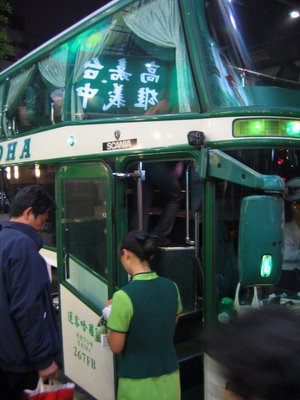
There are many different bus companies, but my vote is definitely with Aloha. Most bus companies charge $500 NT (New Taiwan Dollars – about $15 U.S.), but for an extra $150 NT ($4.50 U.S.) you can ride with Aloha. Why is Aloha so much better? Well, most busses have TV screens that play movies or TV shows on the long bus trips, but you usually don’t get to choose what you watch. Aloha has LCD screens on the back of every seat, so you have your own personal mini-theater. There is a volume control switch on your arm rest and the speakers are built into the left and right sides of your massive headrest, so you have a surround sound system that's loud enough to hear clearly, but quite enough to not disturb other passengers! You can choose from several channels that play Western movies, Chinese movies, Taiwanese TV, children's programming, a GPS image of where you are on the road, a “road cam” showing the road ahead of the bus, and one channel of fully clothed female models dancing or walking to cheesy music. There are two channels of Western (usually cheesy Hollywood) movies with Chinese subtitles to choose from, so the native English speaker doesn't miss out on anything. Your seat reclines waaaaaay back, so you can get very comfortable. An attendant (a girl in a green Aloha uniform) brings you a blanket, something to drink (coffee, tea, or water), a snack, and some wet wipes. There is a bathroom on the bottom level of the deck and a half high bus, but I imagine it is tricky for female passengers to use, since you are using a traditional “squat” toilet on a moving vehicle, but it's still nice to have. Although the movies they show are pretty standard Hollywood crud, they show them on two channels, so you at least can choose the lesser of two evils.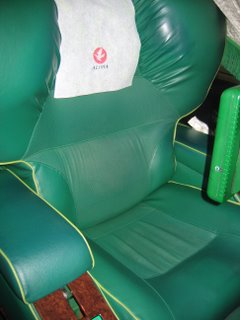
I'll write about the conference I went to last weekend some other time. I have to go to a farewell party for us exchange students in a few minutes, so I don't have time right now. Sorry, but I'm not one to turn down free pizza!
Why start off with a Hawaiian greeting you ask? “Aloha” is the name of my new favorite transportation company. There are many ways of getting around in Taiwan. If you want to go from Kaohsiung to Taipei, you can fly for about $70 U.S. (about a 50 minute flight), take the train for $20-$30 (slow or fast train), or you can take a bus for $15-$20 (which takes 4 or 5 hours, depending on traffic). If you are trying to save money, the bus is absolutely the way to go. I have come to the conclusion that the trains are almost completely useless, since even the fast train only gets you to Taipei an hour faster than the bus and it isn't as comfortable. Intercity busses have large chairs that lean way back – almost like sitting in a moving La-Z-Boy.

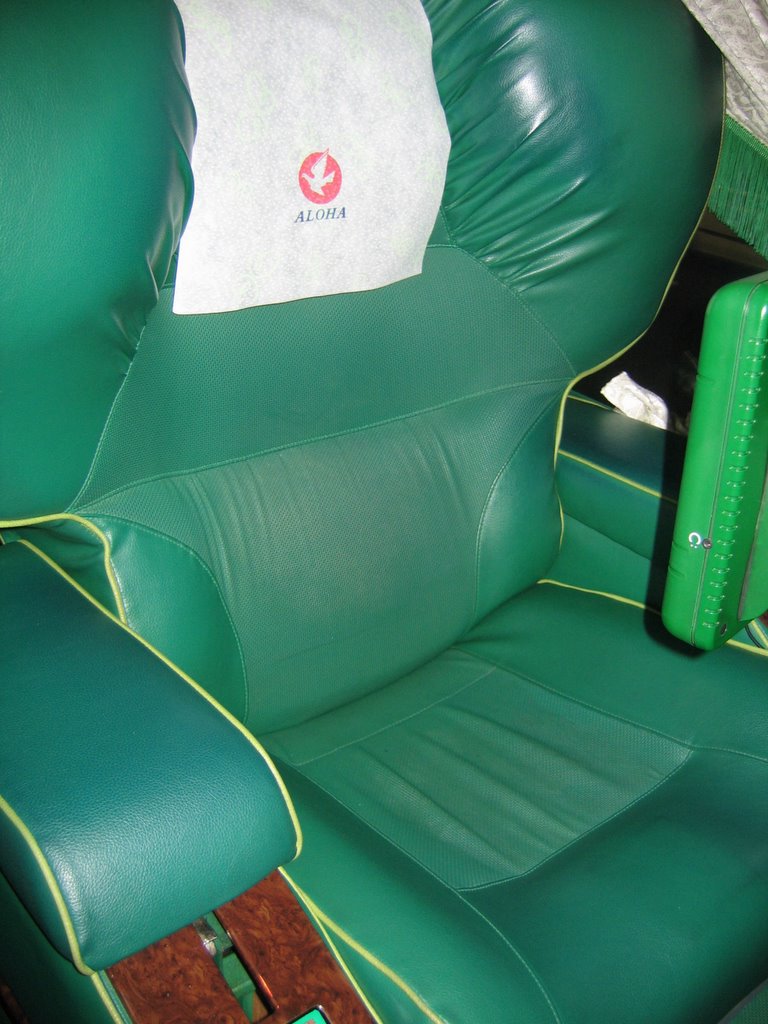
There are many different bus companies, but my vote is definitely with Aloha. Most bus companies charge $500 NT (New Taiwan Dollars – about $15 U.S.), but for an extra $150 NT ($4.50 U.S.) you can ride with Aloha. Why is Aloha so much better? Well, most busses have TV screens that play movies or TV shows on the long bus trips, but you usually don’t get to choose what you watch. Aloha has LCD screens on the back of every seat, so you have your own personal mini-theater. There is a volume control switch on your arm rest and the speakers are built into the left and right sides of your massive headrest, so you have a surround sound system that's loud enough to hear clearly, but quite enough to not disturb other passengers! You can choose from several channels that play Western movies, Chinese movies, Taiwanese TV, children's programming, a GPS image of where you are on the road, a “road cam” showing the road ahead of the bus, and one channel of fully clothed female models dancing or walking to cheesy music. There are two channels of Western (usually cheesy Hollywood) movies with Chinese subtitles to choose from, so the native English speaker doesn't miss out on anything. Your seat reclines waaaaaay back, so you can get very comfortable. An attendant (a girl in a green Aloha uniform) brings you a blanket, something to drink (coffee, tea, or water), a snack, and some wet wipes. There is a bathroom on the bottom level of the deck and a half high bus, but I imagine it is tricky for female passengers to use, since you are using a traditional “squat” toilet on a moving vehicle, but it's still nice to have. Although the movies they show are pretty standard Hollywood crud, they show them on two channels, so you at least can choose the lesser of two evils.
I'll write about the conference I went to last weekend some other time. I have to go to a farewell party for us exchange students in a few minutes, so I don't have time right now. Sorry, but I'm not one to turn down free pizza!
Monday, December 05, 2005
One more question...
To Ross and anyone else who might have wondered...
If you look at old maps of East Asia, you may find that the name of the "Hermit Kingdom" used to be Corea (spelled with a "C"). Both spellings (with a "K" and with a "C") were used in the past, but some Koreans (Coreans) claim that the Japanese promoted the "K" spelling during the colonial period because "J" (for Japan) came before "K" in the alphabet. The spelling "Corea" is now popular mainly with nationalist Coreans (Koreans), though "Korea" remains the official spelling.
If you look at old maps of East Asia, you may find that the name of the "Hermit Kingdom" used to be Corea (spelled with a "C"). Both spellings (with a "K" and with a "C") were used in the past, but some Koreans (Coreans) claim that the Japanese promoted the "K" spelling during the colonial period because "J" (for Japan) came before "K" in the alphabet. The spelling "Corea" is now popular mainly with nationalist Coreans (Koreans), though "Korea" remains the official spelling.
Sunday, December 04, 2005
Some questions...
I had a busy weekend. I will write about it tomorrow, though, because I'm pretty wiped out from 5-hour bus rides, a conference, and a 3 hour Japanese test. For now, I thought I'd try something different and ATTEMPT to answer some questions...
First of all, Ichigo - read my older posts. I'm not posting about Italy until I get back to the U.S. Don't worry, all the details are coming, just not right now!
Now for Ross' series of questions:
"I've always meant to ask but kept forgetting. What dialect of Chinese is spoken in Taiwan? Also, what do they think of America and Japan? How is Chaing Kai Sek viewed in Taiwan? Hero Worship or is he ignored by the populace? Is it taboo to criticize him?"
Forunately you started off with an easy question. The others are much more difficult, but I can say with certainty that I know the answer to the first one.
The dialect of Chinese spoken in Taiwan is... (cue the drum roll):
TAIWANESE!!!
Yes, Taiwanese is the name of the dialect spoken here. It is related to the dialect spoken in the nearby Chinese province of Fujian (which is called, strangely enough, Fujianese). It's not Mandarin and it's not Cantonese, but if you are looking for a better definition of what it is, then you should ask someone who knows more about Chinese than me.
Taiwanese is spoken by those descended from immigrants from Fujian province several centuries ago, but there are other indigenous languages here that should be mentioned. Hakka is spoken by the approximately 13% of Taiwanese who are descended from immigrants from southern Guangdong province. There are also many aboriginal languages that are still spoken in small villages along the East coast and in some of the smaller islands, but there are relatively few people still using these languages today.
Mandarin is still the language of education and most people here understand it, though older people often don't speak it. Citizens of the Republic of China (Taiwan) who came from the Chinese mainland at the end of the Chinese civil war and their descendents often speak Mandarin only.
As for Taiwanese opinions of America and Japan, overall they are very positive. The Taiwanese are unique among the East Asians in their refusal to continue to hold Japan accountable for it's wartime aggression six decades ago. The Japanese did oppress the Taiwanese during their occupation, but they also built schools, hospitals, and other infrastructure that never existed in Taiwan before they came. China, on the other hand, pretty much ignored Taiwan throughout most of history, considering it a rural backwater filled with barbarians - a fact that you are unlikely to hear coming from the mouths of contemporary Chinese historians.
Tens of thousands of Taiwanese died in the service of the Japanese Imperial Army during the war. The Japanese introduced public education and made Japanese the official language. Many older Taiwanese who were educated in this period still speak Japanese more or less fluently. Lee Teng-hui, Taiwan's former president, once claimed in an interview with a Japanese reporter that he considered himself more Japanese than Chinese. (He answered all questions in this interview in eloquent Japanese.)
The brutal, disorganized, corrupt, and incompetent rule of the KMT (Kuomintang - Chiang Kai-shek's "Nationalists") that followed their evacuation to and occupation of Taiwan reinforced the positive image of the Japanese. Many Taiwanese began to look back at the Japanese occupation with nostalgia - especially after the 228 incident, in which tens of thousands of Taiwanese citizens were brutally massacred by the KMT government.
Not all residents of this island hold such positive views of the Japanese, but there is little hostility toward Japan like you will find in China or Corea. Some of the "mainlanders" (KMT members and their families who came here at the end of the civil war), however, fought against the Japanese during the war and still hold a grudge. Recent opinion polls, however, show that the younger generation of this "ethnic group" do not differ in their attitudes toward Japan from their Taiwanese counterparts. Most younger Taiwanese also have a fascination with modern Japan - they love Japanese pop culture, fashion, and food and admire Japan's economic power.
Another reason the Taiwanese like Japan is because it is allied with the U.S. Taiwan relies on the U.S. to deter the PRC from invading. Convincing Japan that Taiwan is worth defending has been a policy priority for Taiwanese leaders for decades. Should a war ever break out over the Taiwan Strait and the U.S. got involved, Japan would have to face the difficult decision of going to war with it's big, bad, scary neighbor or losing it's close and fruitful alliance with the world's only superpower. It's a tough choice and the Taiwanese are unlikely to allow much anti-Japan sentiment to fester here for long.
I think it goes without saying that MOST Taiwanese are very pro-American. Nobody else in the world sells them weapons or hints at coming to their defense if Beijing threatens to attack, so most feel that not liking the U.S. is not an option. This has probably caused some degree of underlying resentment among Taiwanese who dream of a day when they can be independent of foreign influence, but for the most part, it seems unlikely that many Taiwanese would be willing of throwing away close relations with the U.S. if it meant the chances of forced unification with the PRC would increase.
As for your question about Chiang Kai-Shek, I have talked to a few Taiwanese about this, including a fairly long conversation with my roommates just now, and they seem rather ambivalent toward him. He did some bad things and was very strict, but some of his policies helped benefit Taiwan. His insistance on keeping American support strong helped keep Taiwan from being swallowed up by the PRC. Some Taiwanese don't really think of him as being that important of an historical figure. For most of his reign, he focussed almost exclusively on planning and preparing for his ultimate objective - taking China back. He didn't really care too much about Taiwan since he didn't plan on spending too much time here. He left most administrative decisions to bureaucrats and kept a more or less hands off approach. According to my roommates, his wife, Madame Chiang, was more important - she was more personable, more intelligent, and better liked by the Taiwanese. I don't think it would be too taboo to criticize him, but I doubt anyone really cares that much to spend their breath talking bad about him now. There are plenty of corruption scandals in modern Taiwanese politics to focus on!
I hope these at least halfway answered your questions. It was certainly much more than I planned to write. Be back tomorrow!
First of all, Ichigo - read my older posts. I'm not posting about Italy until I get back to the U.S. Don't worry, all the details are coming, just not right now!
Now for Ross' series of questions:
"I've always meant to ask but kept forgetting. What dialect of Chinese is spoken in Taiwan? Also, what do they think of America and Japan? How is Chaing Kai Sek viewed in Taiwan? Hero Worship or is he ignored by the populace? Is it taboo to criticize him?"
Forunately you started off with an easy question. The others are much more difficult, but I can say with certainty that I know the answer to the first one.
The dialect of Chinese spoken in Taiwan is... (cue the drum roll):
TAIWANESE!!!
Yes, Taiwanese is the name of the dialect spoken here. It is related to the dialect spoken in the nearby Chinese province of Fujian (which is called, strangely enough, Fujianese). It's not Mandarin and it's not Cantonese, but if you are looking for a better definition of what it is, then you should ask someone who knows more about Chinese than me.
Taiwanese is spoken by those descended from immigrants from Fujian province several centuries ago, but there are other indigenous languages here that should be mentioned. Hakka is spoken by the approximately 13% of Taiwanese who are descended from immigrants from southern Guangdong province. There are also many aboriginal languages that are still spoken in small villages along the East coast and in some of the smaller islands, but there are relatively few people still using these languages today.
Mandarin is still the language of education and most people here understand it, though older people often don't speak it. Citizens of the Republic of China (Taiwan) who came from the Chinese mainland at the end of the Chinese civil war and their descendents often speak Mandarin only.
As for Taiwanese opinions of America and Japan, overall they are very positive. The Taiwanese are unique among the East Asians in their refusal to continue to hold Japan accountable for it's wartime aggression six decades ago. The Japanese did oppress the Taiwanese during their occupation, but they also built schools, hospitals, and other infrastructure that never existed in Taiwan before they came. China, on the other hand, pretty much ignored Taiwan throughout most of history, considering it a rural backwater filled with barbarians - a fact that you are unlikely to hear coming from the mouths of contemporary Chinese historians.
Tens of thousands of Taiwanese died in the service of the Japanese Imperial Army during the war. The Japanese introduced public education and made Japanese the official language. Many older Taiwanese who were educated in this period still speak Japanese more or less fluently. Lee Teng-hui, Taiwan's former president, once claimed in an interview with a Japanese reporter that he considered himself more Japanese than Chinese. (He answered all questions in this interview in eloquent Japanese.)
The brutal, disorganized, corrupt, and incompetent rule of the KMT (Kuomintang - Chiang Kai-shek's "Nationalists") that followed their evacuation to and occupation of Taiwan reinforced the positive image of the Japanese. Many Taiwanese began to look back at the Japanese occupation with nostalgia - especially after the 228 incident, in which tens of thousands of Taiwanese citizens were brutally massacred by the KMT government.
Not all residents of this island hold such positive views of the Japanese, but there is little hostility toward Japan like you will find in China or Corea. Some of the "mainlanders" (KMT members and their families who came here at the end of the civil war), however, fought against the Japanese during the war and still hold a grudge. Recent opinion polls, however, show that the younger generation of this "ethnic group" do not differ in their attitudes toward Japan from their Taiwanese counterparts. Most younger Taiwanese also have a fascination with modern Japan - they love Japanese pop culture, fashion, and food and admire Japan's economic power.
Another reason the Taiwanese like Japan is because it is allied with the U.S. Taiwan relies on the U.S. to deter the PRC from invading. Convincing Japan that Taiwan is worth defending has been a policy priority for Taiwanese leaders for decades. Should a war ever break out over the Taiwan Strait and the U.S. got involved, Japan would have to face the difficult decision of going to war with it's big, bad, scary neighbor or losing it's close and fruitful alliance with the world's only superpower. It's a tough choice and the Taiwanese are unlikely to allow much anti-Japan sentiment to fester here for long.
I think it goes without saying that MOST Taiwanese are very pro-American. Nobody else in the world sells them weapons or hints at coming to their defense if Beijing threatens to attack, so most feel that not liking the U.S. is not an option. This has probably caused some degree of underlying resentment among Taiwanese who dream of a day when they can be independent of foreign influence, but for the most part, it seems unlikely that many Taiwanese would be willing of throwing away close relations with the U.S. if it meant the chances of forced unification with the PRC would increase.
As for your question about Chiang Kai-Shek, I have talked to a few Taiwanese about this, including a fairly long conversation with my roommates just now, and they seem rather ambivalent toward him. He did some bad things and was very strict, but some of his policies helped benefit Taiwan. His insistance on keeping American support strong helped keep Taiwan from being swallowed up by the PRC. Some Taiwanese don't really think of him as being that important of an historical figure. For most of his reign, he focussed almost exclusively on planning and preparing for his ultimate objective - taking China back. He didn't really care too much about Taiwan since he didn't plan on spending too much time here. He left most administrative decisions to bureaucrats and kept a more or less hands off approach. According to my roommates, his wife, Madame Chiang, was more important - she was more personable, more intelligent, and better liked by the Taiwanese. I don't think it would be too taboo to criticize him, but I doubt anyone really cares that much to spend their breath talking bad about him now. There are plenty of corruption scandals in modern Taiwanese politics to focus on!
I hope these at least halfway answered your questions. It was certainly much more than I planned to write. Be back tomorrow!
Tuesday, November 29, 2005
Taipei weekend
I spent this past weekend (November 26 and 27th) in Taipei. It seems a bit strange to me that I have been in Taiwan for almost three months now and this was my first trip to the capitol, but since I have to spend the next two weekends there as well, I guess it's good that I've already seen most of the rest of the island already.
Originally I had a meeting scheduled with an expert on Taiwan-Japan relations at the Taiwan Think Tank in Taipei on Monday, but he had to reschedule because of a previous engagement. I did have the chance to meet with my professor from Missouri State University (Dr. Hickey), however, so it was still a fruitful trip. Since my next two trips to Taipei are more or less “business trips” (I'm attending a conference on Japan-Taiwan relations next weekend and have my meeting the week after) I wanted to get most of my sight-seeing and tourist side-trips out of the way this weekend, a goal that I think I accomplished.
I boarded the overnight bus from Kaohsiung to Taipei at about 3:00 a.m. Saturday morning after only about an hour and a half of sleep. I thought this would be a great way for me to save time. The bus ride is about five hours, so I thought I could just get five hours of sleep in transit and wake up in Taipei in the morning so I could have the whole day to tour the city. This turned out to be mere wishful thinking. The bus was freezing cold and the driver didn't turn off the TVs that played Taiwanese news all night. I don't know why, but even though it's not hot anymore, the intercity busses still all have the AC pumping on their overnight routes. Bizarre…
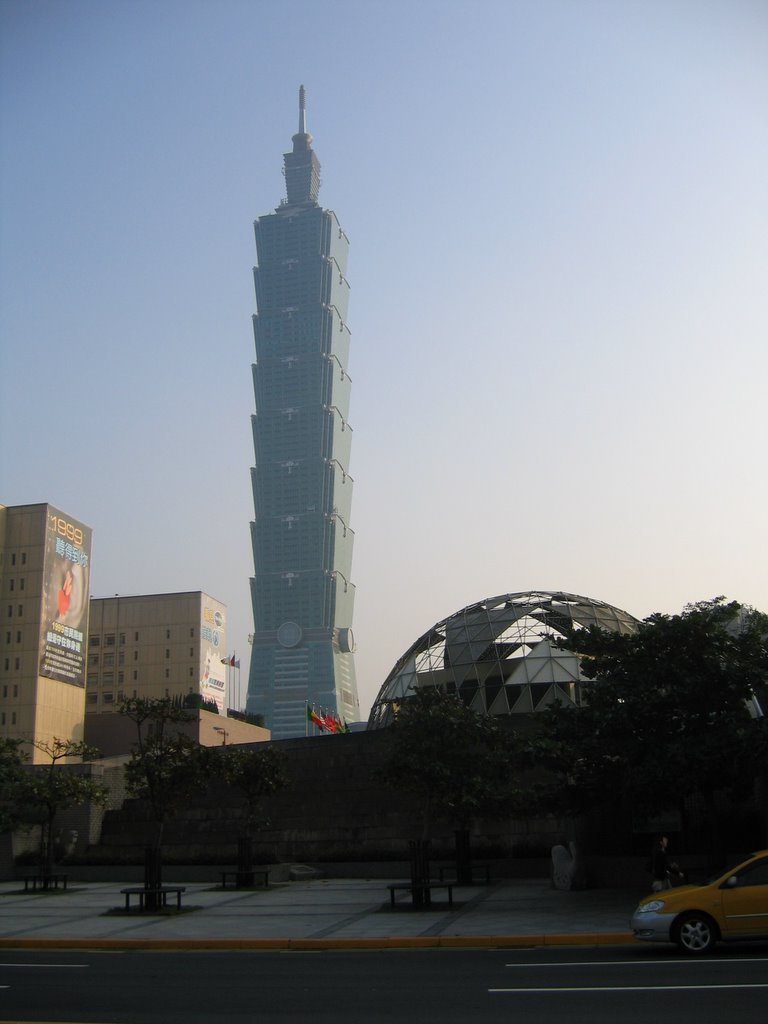
I arrived exhausted in Taipei at about 8:30 in the morning. I threw my suitcase into a coin locker and headed off for a greasy breakfast at McDonald's. I was set on seeing Taipei 101, the tallest building in the world, so I consulted my Lonely Planet guidebook to see what other sights were in that neighborhood. I decided to go to the “Discovery Center” at Taipei City Hall, across the street from the 101 building. They have some interesting displays about the city's history and have a free English audio tour recording you can borrow to lead you through the exhibits. I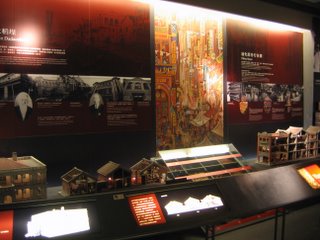 thought the displays on Taipei's early history were interesting, but the “city today” section was way too touristy.
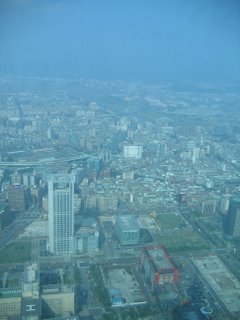
I then crossed the street and headed for the elevator to the observation floors at Taipei 101. You pay about six dollars to ride the world's fastest elevator to the 89th floor observatory of the world's tallest building (a fact which they make sure is not lost on visitors) to get a bird's eye view of a smoggy urban view. I'm sure there are days when the smog isn't too bad, but it was very thick on Saturday. I also shelled out the extra few dollars to climb the two flights of stairs to the outdoor observation area on the 91st floor, which gives you basically the same view, but with a little fresher air than you might get at street level. Unfortunately, the smog was so bad that many of the sights the audio tour pointed out where shrouded in a gray haze.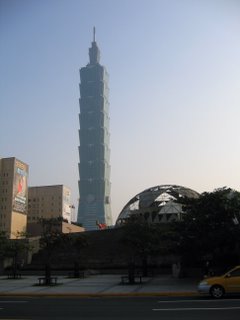
For lunch, I stopped by Ruby Tuesday's for a salad bar and buffalo wings. How exotic! Yes, it's a cop-out, but I think I deserve to eat crappy American food every now and then! All I'm going to say about that overpriced meal is that they had bleu cheese dressing, so I was very pleased.
After lunch I walked to the Sun Yat-sen Memorial Hall. This memorial hall and park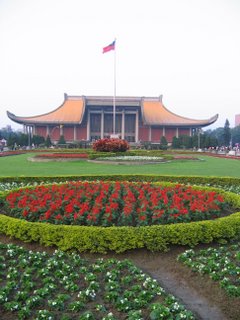
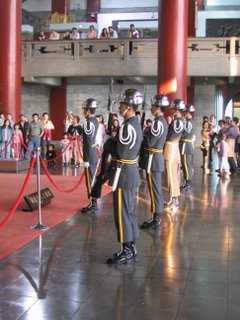 are easily seen from the top of Taipei 101, as they occupy one large city block. The hall itself is a large traditional Chinese building that enshrines a big statue of Dr. Sun Yat-sen, the founder of the KMT, the Chinese Nationalist Party that eventually fled to Taiwan to establish the Republic of China (the official name of the government of Taiwan). There are some exhibition rooms in the back with interesting historical tidbits, but English translations are few and far between. One hallway that did have English translations housed an exhibit of photographs of the Sino-Japanese conflict throughout Sun Yat-sen's leadership. As I was looking at some of the exhibits, one of the employees asked me if I wanted to watch the changing of the guards ceremony (the last one of the day). I said yes and stood for what seemed like a very long and unnecessarily long, but very well-executed, ceremony. I took a lot of pictures, but only a few turned out well. If you're ever make it to this memorial, be sure to check out this hourly show.
The park outside seems to be very popular as a weekend getaway spot among the locals. There were groups of old men playing Chinese checkers, groups of young people practicing their dance moves, kids and old people flying kites, families playing ball, and at least one kung-fu class. It was really nice to see all these people having a good time together on a beautiful November day in Taipei (which feels like a June day in Missouri!).
After wandering the city just a wee bit longer and stopping by the Internet café, I went to my friend's house to get some sleep. Katannya, a Canadian English teacher, lives in a really nice apartment on the outskirts of the city with three or four other roommates. They are all foreign English teachers and they seem to have a pretty good set-up here. Thanks to all of them for putting me up this weekend!
I got a much-needed full night's sleep and went to meet Dr. Hickey for lunch on Sunday. We ate at a restaurant called “Skylark”, which at first I thought was a Japanese chain restaurant of the same name. Thankfully, it wasn't. The Taiwanese Skylark is a Taiwanese version of western food. The Japanese Skylark is a Japanese version of an American diner with Japanese and Western food, but the Taiwanese chain is much better. You order from a set menu that includes a salad, an appetizer, a main course, a dessert, and coffee or tea at the end. It was a very satisfying meal.
It was really good to see Dr. Hickey here in Taiwan. He has been instrumental in helping me pursue my study of East Asian politics while at Missouri State University. He is an expert in Taiwan-U.S. relations and is responsible for setting up the exchange program that I am currently participating in. He is on sabbatical this semester and has been in Taiwan for about three weeks researching a book he is writing on Taiwan's foreign policy. I got to hear his thoughts on many issues in Taiwanese politics and I particularly enjoyed his stories about his recent interview with Lee Teng-hui, the former president of Taiwan. We chatted for over an hour, then decided to head over to the former residence of Chiang Kai Shek, the former dictator of Taiwan.
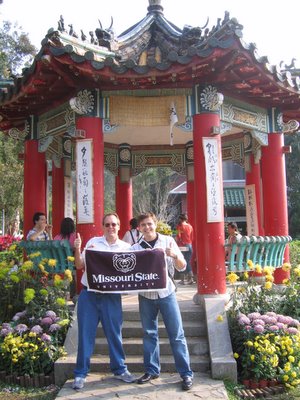
Chiang's house is closed to the public, but his massive garden is open and is apparently a popular spot for a Sunday stroll. We chatted some more about politics, international relations, and the joys and travails of travel as we soaked in the warm weather and beautiful scenery.
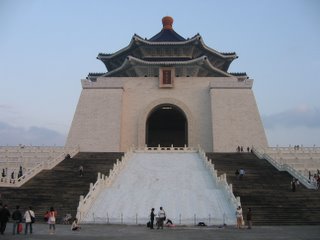
We parted ways at about 3:00 and I decided to go see the Chiang Kai Shek Memorial Hall. It is larger and more impressive than the Sun Yat-sen Memorial, but the quirky smile Chiang bears seems very out-of-place. I guess if you're going to build a memorial to a dictator, you should at least make him a happy dictator!
The museum here is much more interesting and has many more English translations than at the other memorial. Two of the generalissimo's bullet-proof Cadillacs are on display, as are many of his personal items, medals, awards, clothes, calligraphy, and furniture. Lighted signs explain in Chinese and English various episode's in his life. All of these are written with a (brace yourself!) slight pro-Chiang slant. I don't know if any of you are aware of this, but sometimes people who build memorials to dictators aren't exactly the most unbiased people in the world. Apparently, even though Taiwan didn't become a democratic country until the early to mid 1990s, Chiang was responsible for Taiwan's democratization (he died in 1975). Yes, those Chinese ghosts are very powerful.
After another dinner of American food, I went to the infamous Snake Alley. This is actually just one street of a massive night market in Taipei. The economy of this area was once based on the world's oldest profession, but the police have apparently pushed prostitution out of the area so they could turn it into a tourist and family friendly night market. Odd remnants of the old raunchy atmosphere remain in the form of booths and stores that specialize in adult toys, which seem oddly out of place in the midst of noodle stands, tea shops, and knock-off brand name clothing merchants.
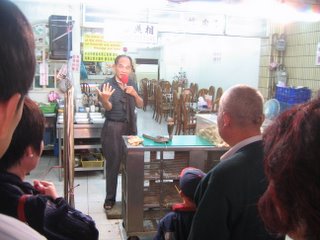
The big draw in Snake Alley is, of course, the snakes. I only saw about three or four shops that still kept live snakes, which they will kill, cut, clean, and cook right there for you if you are so inclined. Snake handlers wear microphone headsets and yell out the crowd as any good side-show worker would to entice the curious to join the dark side. You aren't allowed to take pictures, but I managed to snap a few before they yelled at me.
I have a pet snake at home and I am probably a little biased, but the shows were a little frustrating to watch. I have no objection to people eating whatever animal they want, as long as it isn't endangered and it isn't going to start another SARS scare. It was the “entertainment” part of the show that was really disheartening. One guy tried to feed a mouse to some small non-poisonous snakes in front of a huge crowd, but they didn't take any interest in the food. Another guy kept smacking his cobras on the head after they tried to bite him. If I had that guy yelling in my face and waking me up all day long, I think I would try to bite him, too.
Well, this was a long post and I don't think I had much of a chance to reflect on these experiences, but I'm going to end it here. It's been a long time since I last posted, so I really wanted to get this up while it's still fresh in my mind. I'll try to post again before I get through a whole weekend next time!
Originally I had a meeting scheduled with an expert on Taiwan-Japan relations at the Taiwan Think Tank in Taipei on Monday, but he had to reschedule because of a previous engagement. I did have the chance to meet with my professor from Missouri State University (Dr. Hickey), however, so it was still a fruitful trip. Since my next two trips to Taipei are more or less “business trips” (I'm attending a conference on Japan-Taiwan relations next weekend and have my meeting the week after) I wanted to get most of my sight-seeing and tourist side-trips out of the way this weekend, a goal that I think I accomplished.
I boarded the overnight bus from Kaohsiung to Taipei at about 3:00 a.m. Saturday morning after only about an hour and a half of sleep. I thought this would be a great way for me to save time. The bus ride is about five hours, so I thought I could just get five hours of sleep in transit and wake up in Taipei in the morning so I could have the whole day to tour the city. This turned out to be mere wishful thinking. The bus was freezing cold and the driver didn't turn off the TVs that played Taiwanese news all night. I don't know why, but even though it's not hot anymore, the intercity busses still all have the AC pumping on their overnight routes. Bizarre…
I arrived exhausted in Taipei at about 8:30 in the morning. I threw my suitcase into a coin locker and headed off for a greasy breakfast at McDonald's. I was set on seeing Taipei 101, the tallest building in the world, so I consulted my Lonely Planet guidebook to see what other sights were in that neighborhood. I decided to go to the “Discovery Center” at Taipei City Hall, across the street from the 101 building. They have some interesting displays about the city's history and have a free English audio tour recording you can borrow to lead you through the exhibits. I
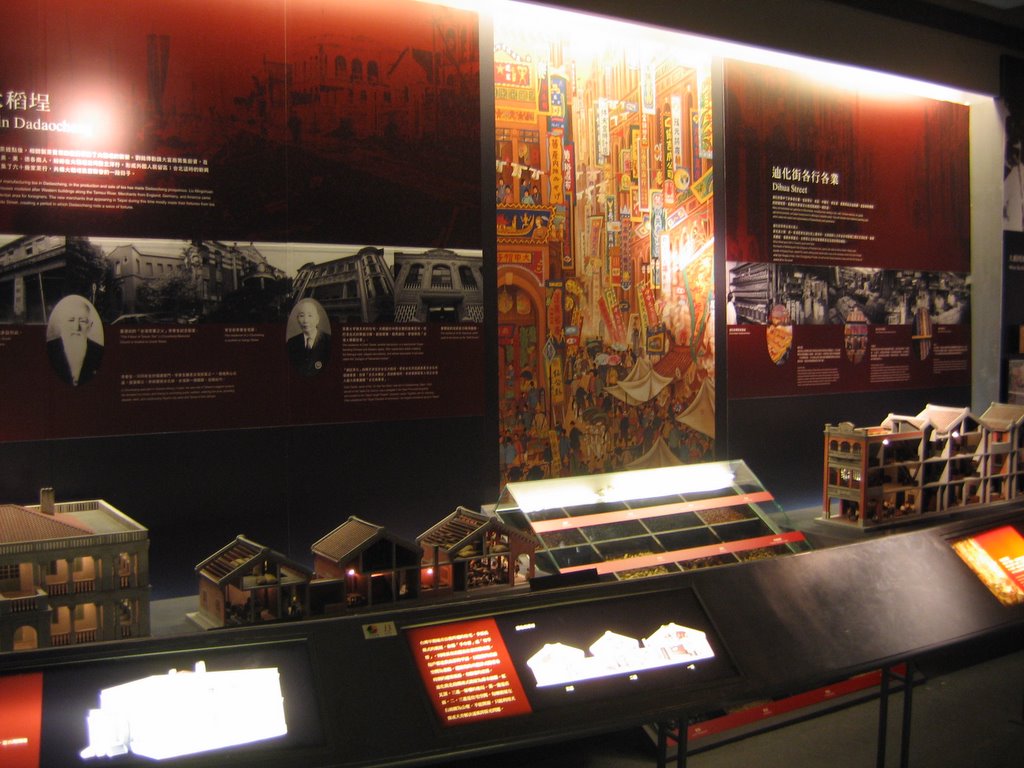 thought the displays on Taipei's early history were interesting, but the “city today” section was way too touristy.
I then crossed the street and headed for the elevator to the observation floors at Taipei 101. You pay about six dollars to ride the world's fastest elevator to the 89th floor observatory of the world's tallest building (a fact which they make sure is not lost on visitors) to get a bird's eye view of a smoggy urban view. I'm sure there are days when the smog isn't too bad, but it was very thick on Saturday. I also shelled out the extra few dollars to climb the two flights of stairs to the outdoor observation area on the 91st floor, which gives you basically the same view, but with a little fresher air than you might get at street level. Unfortunately, the smog was so bad that many of the sights the audio tour pointed out where shrouded in a gray haze.
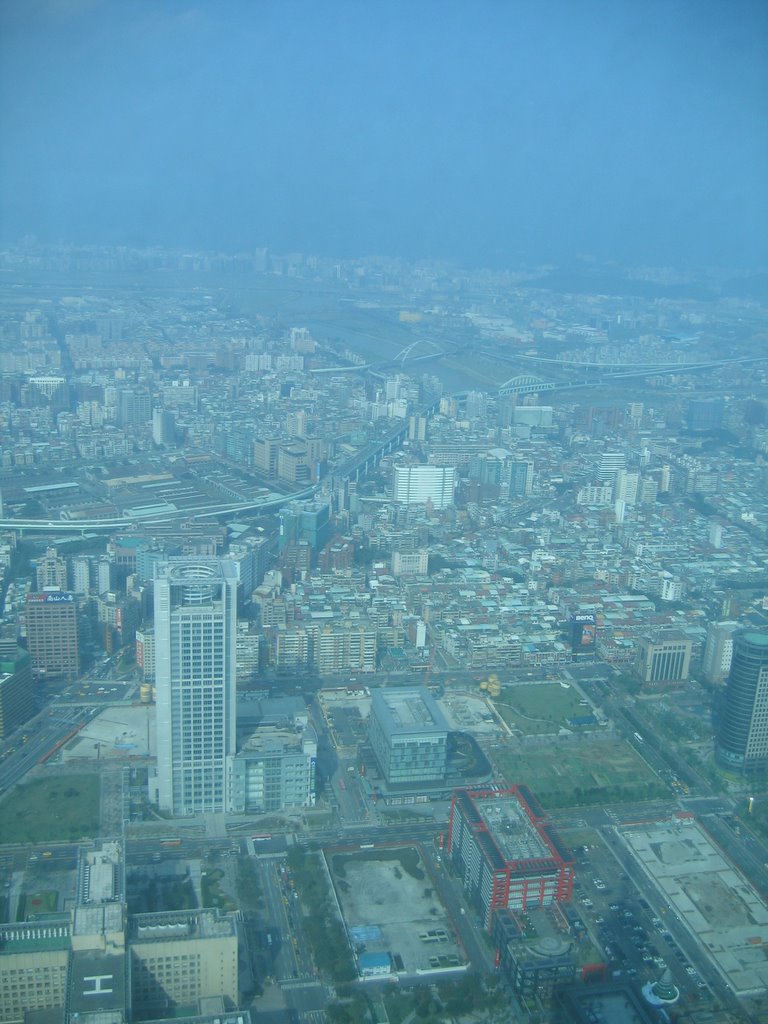
For lunch, I stopped by Ruby Tuesday's for a salad bar and buffalo wings. How exotic! Yes, it's a cop-out, but I think I deserve to eat crappy American food every now and then! All I'm going to say about that overpriced meal is that they had bleu cheese dressing, so I was very pleased.
After lunch I walked to the Sun Yat-sen Memorial Hall. This memorial hall and park
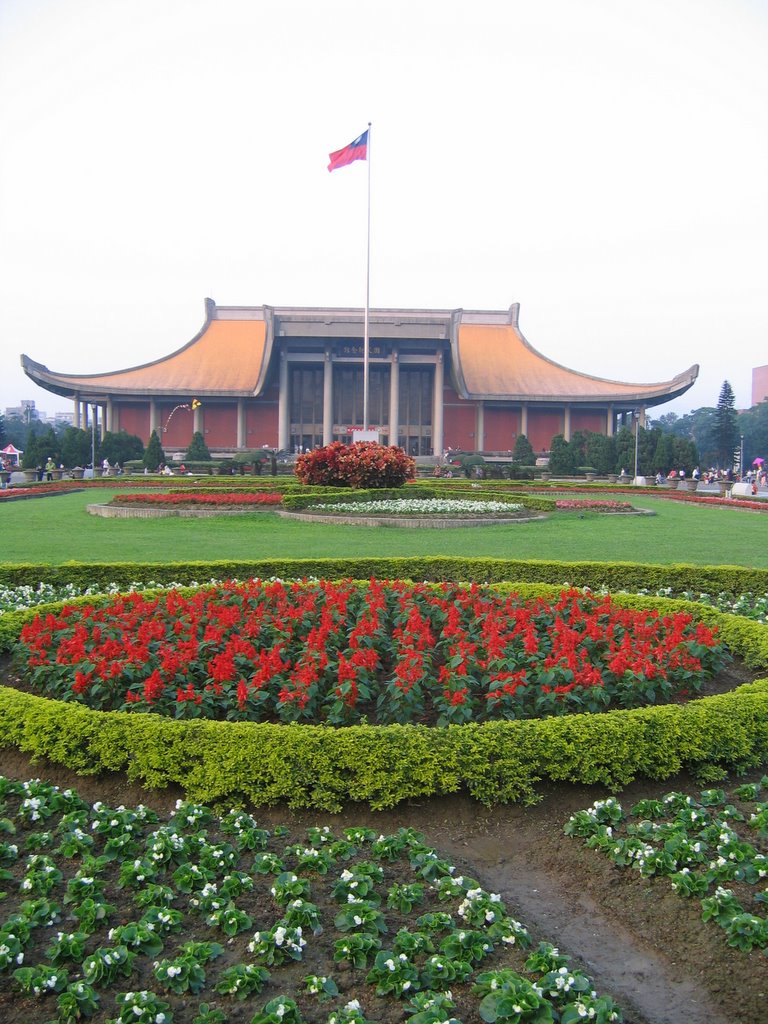
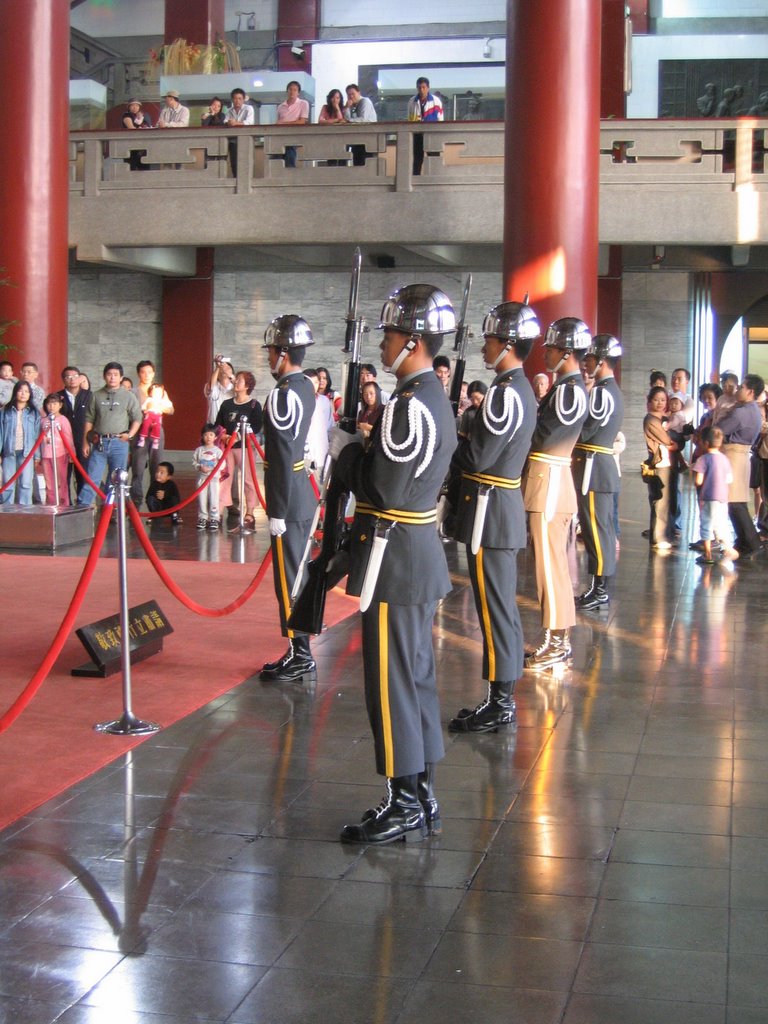 are easily seen from the top of Taipei 101, as they occupy one large city block. The hall itself is a large traditional Chinese building that enshrines a big statue of Dr. Sun Yat-sen, the founder of the KMT, the Chinese Nationalist Party that eventually fled to Taiwan to establish the Republic of China (the official name of the government of Taiwan). There are some exhibition rooms in the back with interesting historical tidbits, but English translations are few and far between. One hallway that did have English translations housed an exhibit of photographs of the Sino-Japanese conflict throughout Sun Yat-sen's leadership. As I was looking at some of the exhibits, one of the employees asked me if I wanted to watch the changing of the guards ceremony (the last one of the day). I said yes and stood for what seemed like a very long and unnecessarily long, but very well-executed, ceremony. I took a lot of pictures, but only a few turned out well. If you're ever make it to this memorial, be sure to check out this hourly show.
The park outside seems to be very popular as a weekend getaway spot among the locals. There were groups of old men playing Chinese checkers, groups of young people practicing their dance moves, kids and old people flying kites, families playing ball, and at least one kung-fu class. It was really nice to see all these people having a good time together on a beautiful November day in Taipei (which feels like a June day in Missouri!).
After wandering the city just a wee bit longer and stopping by the Internet café, I went to my friend's house to get some sleep. Katannya, a Canadian English teacher, lives in a really nice apartment on the outskirts of the city with three or four other roommates. They are all foreign English teachers and they seem to have a pretty good set-up here. Thanks to all of them for putting me up this weekend!
I got a much-needed full night's sleep and went to meet Dr. Hickey for lunch on Sunday. We ate at a restaurant called “Skylark”, which at first I thought was a Japanese chain restaurant of the same name. Thankfully, it wasn't. The Taiwanese Skylark is a Taiwanese version of western food. The Japanese Skylark is a Japanese version of an American diner with Japanese and Western food, but the Taiwanese chain is much better. You order from a set menu that includes a salad, an appetizer, a main course, a dessert, and coffee or tea at the end. It was a very satisfying meal.
It was really good to see Dr. Hickey here in Taiwan. He has been instrumental in helping me pursue my study of East Asian politics while at Missouri State University. He is an expert in Taiwan-U.S. relations and is responsible for setting up the exchange program that I am currently participating in. He is on sabbatical this semester and has been in Taiwan for about three weeks researching a book he is writing on Taiwan's foreign policy. I got to hear his thoughts on many issues in Taiwanese politics and I particularly enjoyed his stories about his recent interview with Lee Teng-hui, the former president of Taiwan. We chatted for over an hour, then decided to head over to the former residence of Chiang Kai Shek, the former dictator of Taiwan.
Chiang's house is closed to the public, but his massive garden is open and is apparently a popular spot for a Sunday stroll. We chatted some more about politics, international relations, and the joys and travails of travel as we soaked in the warm weather and beautiful scenery.

We parted ways at about 3:00 and I decided to go see the Chiang Kai Shek Memorial Hall. It is larger and more impressive than the Sun Yat-sen Memorial, but the quirky smile Chiang bears seems very out-of-place. I guess if you're going to build a memorial to a dictator, you should at least make him a happy dictator!
The museum here is much more interesting and has many more English translations than at the other memorial. Two of the generalissimo's bullet-proof Cadillacs are on display, as are many of his personal items, medals, awards, clothes, calligraphy, and furniture. Lighted signs explain in Chinese and English various episode's in his life. All of these are written with a (brace yourself!) slight pro-Chiang slant. I don't know if any of you are aware of this, but sometimes people who build memorials to dictators aren't exactly the most unbiased people in the world. Apparently, even though Taiwan didn't become a democratic country until the early to mid 1990s, Chiang was responsible for Taiwan's democratization (he died in 1975). Yes, those Chinese ghosts are very powerful.
After another dinner of American food, I went to the infamous Snake Alley. This is actually just one street of a massive night market in Taipei. The economy of this area was once based on the world's oldest profession, but the police have apparently pushed prostitution out of the area so they could turn it into a tourist and family friendly night market. Odd remnants of the old raunchy atmosphere remain in the form of booths and stores that specialize in adult toys, which seem oddly out of place in the midst of noodle stands, tea shops, and knock-off brand name clothing merchants.
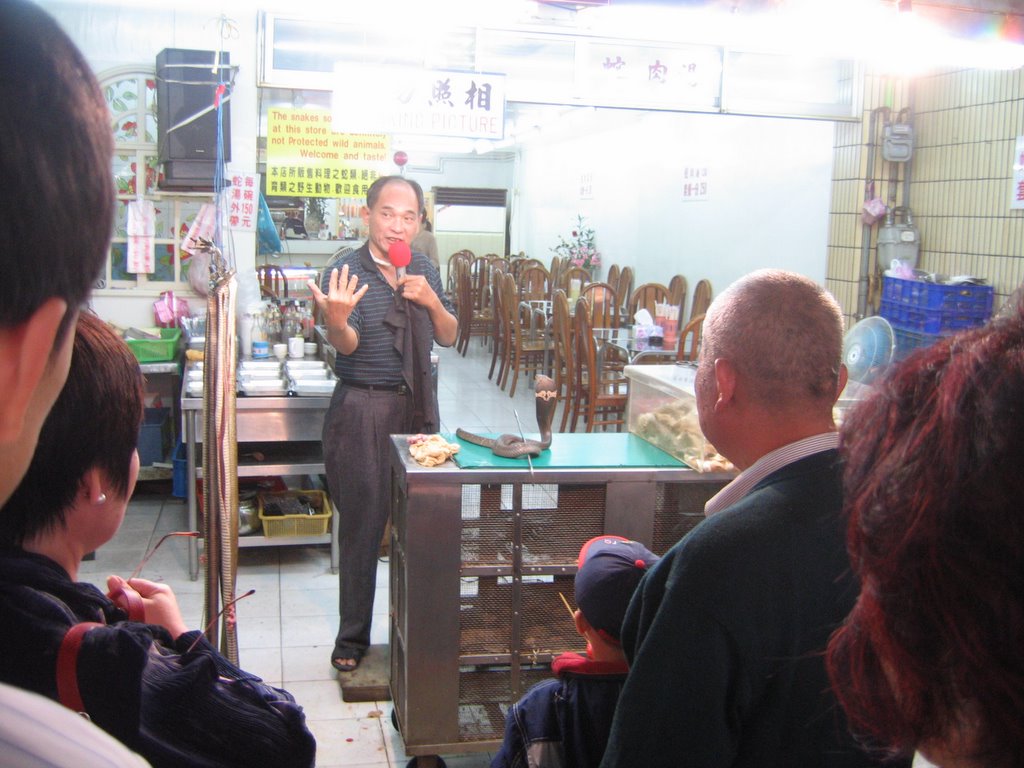
The big draw in Snake Alley is, of course, the snakes. I only saw about three or four shops that still kept live snakes, which they will kill, cut, clean, and cook right there for you if you are so inclined. Snake handlers wear microphone headsets and yell out the crowd as any good side-show worker would to entice the curious to join the dark side. You aren't allowed to take pictures, but I managed to snap a few before they yelled at me.
I have a pet snake at home and I am probably a little biased, but the shows were a little frustrating to watch. I have no objection to people eating whatever animal they want, as long as it isn't endangered and it isn't going to start another SARS scare. It was the “entertainment” part of the show that was really disheartening. One guy tried to feed a mouse to some small non-poisonous snakes in front of a huge crowd, but they didn't take any interest in the food. Another guy kept smacking his cobras on the head after they tried to bite him. If I had that guy yelling in my face and waking me up all day long, I think I would try to bite him, too.
Well, this was a long post and I don't think I had much of a chance to reflect on these experiences, but I'm going to end it here. It's been a long time since I last posted, so I really wanted to get this up while it's still fresh in my mind. I'll try to post again before I get through a whole weekend next time!
Monday, November 21, 2005
Seven-hour layover...
My Italian vacation is at an end and it's time for me to get back to the grind of life as an international student. It's a LONG trip from my hotel in Milan to my dorm room in Kaohsiung - probably about 36 hours. I've already finished one taxi ride, one subway trip (carrying my luggage and transfering once), one bus ride, and one plane ride. I'm almost done with my seven hour layover in Amsterdam, but I still have a 10 and a half hour flight (Amsterdam to Bangkok), a one-hour layover, a 3 and a half hour flight (Bangkok to Taipei), a five-hour bus ride (Taipei to Kaohsiung), and a twenty minute cab ride to go. Wee!!!
My mom really made my day about a week and a half ago when she told me that I can only make these long trips while I'm "still young" - but after a little more than a week of touring northern Italy, I don't feel all that young anymore.
Italy was amazing and Maiko and I took a ton of pictures! I will try to post some of the good ones on flickr this week, but (as I mentioned before) I probably won't write about my travels until sometime between Christmas and New Years. I only have one month left in Taiwan and it's STUDY TIME!!! I have an interview to do in Taipei on Monday with a former DPP (Democratic People's Party - the current ruling party in Taiwan) official who works at a foreign policy think tank and is an expert in Japan-Taiwan relations, so I will probably use that as an excuse to spend a few days in Taipei this weekend. Other than that, I don't plan on making too many more trips around the "renegade province" because I have too much work to do. We have a nice monkey-infested mountain on campus that I have yet to climb, so the mountain and the beach will be my avenues of escape when I need a study break.
Nothing else really to report right now. I have some Chinese homework to do on the plane, but I think we're going to have some mildly entertaining movies to watch, so I might not get much done until I get on the intercity bus in Taiwan.
Sorry for rambling so much, but I'm a little sleep-deprived and tired from hanging out in the airport for so long. I will try to post something insightful this week, but no promises!
My mom really made my day about a week and a half ago when she told me that I can only make these long trips while I'm "still young" - but after a little more than a week of touring northern Italy, I don't feel all that young anymore.
Italy was amazing and Maiko and I took a ton of pictures! I will try to post some of the good ones on flickr this week, but (as I mentioned before) I probably won't write about my travels until sometime between Christmas and New Years. I only have one month left in Taiwan and it's STUDY TIME!!! I have an interview to do in Taipei on Monday with a former DPP (Democratic People's Party - the current ruling party in Taiwan) official who works at a foreign policy think tank and is an expert in Japan-Taiwan relations, so I will probably use that as an excuse to spend a few days in Taipei this weekend. Other than that, I don't plan on making too many more trips around the "renegade province" because I have too much work to do. We have a nice monkey-infested mountain on campus that I have yet to climb, so the mountain and the beach will be my avenues of escape when I need a study break.
Nothing else really to report right now. I have some Chinese homework to do on the plane, but I think we're going to have some mildly entertaining movies to watch, so I might not get much done until I get on the intercity bus in Taiwan.
Sorry for rambling so much, but I'm a little sleep-deprived and tired from hanging out in the airport for so long. I will try to post something insightful this week, but no promises!
Tuesday, November 15, 2005
Viva Italia!!!
I don't think I'm not going to get into any details yet, but just to let you know, I am in Italy safe and having a great time! I have only been here four days but already have a ton of pictures, so I will try to load everything and update when I get back to Taiwan...
Until then, ciao!
Until then, ciao!
Thursday, November 10, 2005
Italy, here I come!!!
Well, I didn't post anything about the last day of our East Coast trip, but we basically just had a long drive back along another twisting road of doom, blah, blah, blah...
The big news is: I'M GOING TO ITALY!!!
Yep, someone is coming to my dorm room in about 30 minutes to take me to the Kaohsiung Airport. Then I fly to Taipei, take a bus from one airport to another in Taipei, fly from Taipei to Bangkok, then from Bangkok to Amsterdam, then Amsterdam to Rome. Then, I have to take a train from the Rome airport to the main train station, change trains, and take another train to the main train station in Florence, where I will meet Maiko and we will go to our hotel. All told, it should take just over 36 hours to get from here to there, but it's my first time to Europe, so I think the excitement will make the traveling part a little easier. Maybe... It's the coming back part that will be really hard...
Well, what can I say?!? WOO-HOO just doesn't seem to capture it. I'm really excited to be going to Italy, seeing famous sites, eating delicious Italian food, and of course, seeing my wonderful girlfriend whom I haven't seen in more than two months! I'll try to post and put up some pictures on flickr from Italy, but I doubt I'll have time to write too much. Keep watching anyway, though. Ciao!
The big news is: I'M GOING TO ITALY!!!
Yep, someone is coming to my dorm room in about 30 minutes to take me to the Kaohsiung Airport. Then I fly to Taipei, take a bus from one airport to another in Taipei, fly from Taipei to Bangkok, then from Bangkok to Amsterdam, then Amsterdam to Rome. Then, I have to take a train from the Rome airport to the main train station, change trains, and take another train to the main train station in Florence, where I will meet Maiko and we will go to our hotel. All told, it should take just over 36 hours to get from here to there, but it's my first time to Europe, so I think the excitement will make the traveling part a little easier. Maybe... It's the coming back part that will be really hard...
Well, what can I say?!? WOO-HOO just doesn't seem to capture it. I'm really excited to be going to Italy, seeing famous sites, eating delicious Italian food, and of course, seeing my wonderful girlfriend whom I haven't seen in more than two months! I'll try to post and put up some pictures on flickr from Italy, but I doubt I'll have time to write too much. Keep watching anyway, though. Ciao!
Sunday, November 06, 2005
East Coast Road Trip - Day Three (The Scenic Route, Take Two)
My theory that every good day starts off with a greasy breakfast was further proved on Sunday. We felt like taking it a little slower after having such a long day on Saturday, so we slept until almost 9:00 and went to McDonald's for breakfast. Unfortunately, we arrived as they were changing from the breakfast menu to the burger menu, so some of our group couldn't get breakfast. Being the first one in (I practically sprinted in the door), though, I was safe.
After breakfast we noticed a community group giving massages across the street. They had many massage chairs set up under a tent and urged us to come over. This group turned out to be a local community group of blind people who were giving out free massages to all that came by. I wound up getting two massages that felt good at first, but I think our visually impaired friends didn't know their own strength. They REALLY dug in! Ouch! It was painful at the time, but I think it did help loosen me up because my stiff neck felt better afterwards.
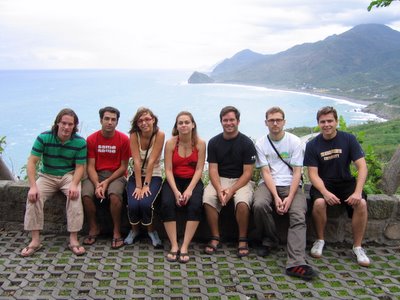
After our greasy breakfast, free massages, and a few cups of coffee, we hit the road. It was a little chilly and raining lightly, but we weren't planning on doing any long hikes today, so we were fine with the weather. We decided to go down the East Coast highway and stop at a few sights listed in the guidebooks to see if any of them were any good. Our first stop was a scenic overlook where we managed to get this group photo.
We stopped at some little fishing town where you are supposed to be able to take whale-watching tours. Adi really had his heart set on waking up the next morning to see some whales, but they informed us the season was over. Too bad!
Our next stop was the Tropic of Cancer monument. I loaded a picture of this on flickr, but it's hardly worth mentioning. Needless to say, we were extremely disappointed when we crossed to the tropics and the weather didn't warm up.
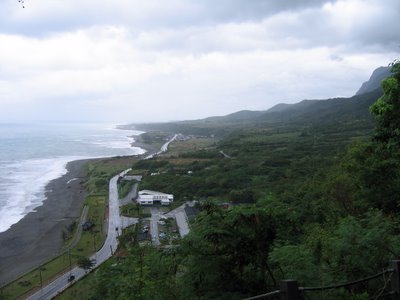
Next, we stopped at the Basian caves. There are eight or nine of these "caves", which are very shallow. Some of them could probably just be called "overhangs", but the scenery from the top of the walkway to the higher caves was quite impressive. There are temples in each of the caves, but the caves themselves are not that big, so it was a bit of a let-down.
We stopped for a bite to eat in the town of Chenggong. We then backtracked a mile or two to visit the Sansiantai Bridge. This wave-shaped bridge was built in 1987, but has already become a popular tourist attraction. The small island it connects with the mainland hosts three large rock formations that are said to resemble three Taoist immortals who visited the are long ago (although I didn't see any resemblance).
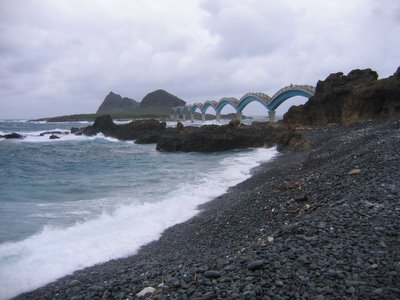
I had seen some beautiful pictures of the bridge and the island in sunlight, but it was much more challenging to take photos in near hurricane conditions. Although it wasn't raining hard, the wind was blowing so strongly that the raindrops pelted you in the face like little bb's. It was especially bad on the bridge, which was a shame because the views of waves crashing into rocks and the different colors of the ocean at different depths were really dramatic. I managed to snap a few pictures that weren't blurry and kept my camera sheltered enough from the weather that it didn't malfunction, which I thought was a stroke of luck.
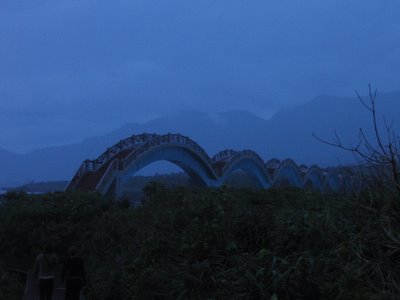
It was getting dark as we left the bridge area. Once again, I had the brilliant idea of taking “the scenic route”, which AGAIN turned out to be less than a highway, as the map indicated. ONCE AGAIN, we found ourselves on a “winding narrow path of doom”. Yes, I take full responsibility for the poor navigation, but hey, if you looked at a road map of Taiwan, I think you would agree that highway 23 looked like a shortcut. Anyway, Adi was brave enough to take us on an even more winding “road” at night and managed to keep us all in one piece. I put “road” in quotation marks because at least half of 23 is still under construction.
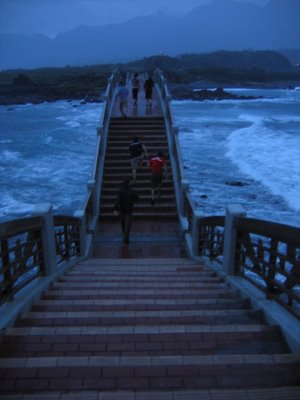
When we made it to the inland highway (a proper highway, by the way) the going was much smoother. We called the lady at a travel agency and asked her to contact our innkeeper in Ruishuei to come meet us at the train station and guide us to our lodgings. The Ruishuei Hot Springs hotel was a very pleasant spot. This inn was built by the Japanese about one hundred years ago. The rooms are Japanese style, with tatami mats and futons you lay on the floor. There are hot and cold spring water pools near the front desk for free use by the guests. Not too shabby at about $10 U.S. a night per person!
We went to town for dinner and soaked in the hot water for a while before dinner. The Europeans seemed pretty happy spending about half their time in the cold water, but I could only enter for about 10 or 20 seconds at a time before I had to jump in the warm water. I think it felt even better because it was a little chilly and drizzling outside as we sat and soaked.
We all slept well and the girls had a hard time waking us up in the morning. They probably slept more soundly than we did, though, because there were only the two of them in one room, while us guys were five in the other room. There was also some REALLY crazy animal fight right outside our window at 4 or 5 in the morning, but we were all too tired to go see what was going on. Whatever it was, it was all cleaned up by morning, and the big golden lab who sits chained out front wasn't hurt.
Well, I have procrastinated on my schoolwork today long enough. It's 11:00 at night and I need to try to finish one of my presentations tonight. I only have one more day of our road trip to post on, but I'll wait until at least tomorrow to write it. It wasn't too eventful, so it shouldn't take too long.
After breakfast we noticed a community group giving massages across the street. They had many massage chairs set up under a tent and urged us to come over. This group turned out to be a local community group of blind people who were giving out free massages to all that came by. I wound up getting two massages that felt good at first, but I think our visually impaired friends didn't know their own strength. They REALLY dug in! Ouch! It was painful at the time, but I think it did help loosen me up because my stiff neck felt better afterwards.
After our greasy breakfast, free massages, and a few cups of coffee, we hit the road. It was a little chilly and raining lightly, but we weren't planning on doing any long hikes today, so we were fine with the weather. We decided to go down the East Coast highway and stop at a few sights listed in the guidebooks to see if any of them were any good. Our first stop was a scenic overlook where we managed to get this group photo.
We stopped at some little fishing town where you are supposed to be able to take whale-watching tours. Adi really had his heart set on waking up the next morning to see some whales, but they informed us the season was over. Too bad!
Our next stop was the Tropic of Cancer monument. I loaded a picture of this on flickr, but it's hardly worth mentioning. Needless to say, we were extremely disappointed when we crossed to the tropics and the weather didn't warm up.
Next, we stopped at the Basian caves. There are eight or nine of these "caves", which are very shallow. Some of them could probably just be called "overhangs", but the scenery from the top of the walkway to the higher caves was quite impressive. There are temples in each of the caves, but the caves themselves are not that big, so it was a bit of a let-down.
We stopped for a bite to eat in the town of Chenggong. We then backtracked a mile or two to visit the Sansiantai Bridge. This wave-shaped bridge was built in 1987, but has already become a popular tourist attraction. The small island it connects with the mainland hosts three large rock formations that are said to resemble three Taoist immortals who visited the are long ago (although I didn't see any resemblance).
I had seen some beautiful pictures of the bridge and the island in sunlight, but it was much more challenging to take photos in near hurricane conditions. Although it wasn't raining hard, the wind was blowing so strongly that the raindrops pelted you in the face like little bb's. It was especially bad on the bridge, which was a shame because the views of waves crashing into rocks and the different colors of the ocean at different depths were really dramatic. I managed to snap a few pictures that weren't blurry and kept my camera sheltered enough from the weather that it didn't malfunction, which I thought was a stroke of luck.
It was getting dark as we left the bridge area. Once again, I had the brilliant idea of taking “the scenic route”, which AGAIN turned out to be less than a highway, as the map indicated. ONCE AGAIN, we found ourselves on a “winding narrow path of doom”. Yes, I take full responsibility for the poor navigation, but hey, if you looked at a road map of Taiwan, I think you would agree that highway 23 looked like a shortcut. Anyway, Adi was brave enough to take us on an even more winding “road” at night and managed to keep us all in one piece. I put “road” in quotation marks because at least half of 23 is still under construction.
When we made it to the inland highway (a proper highway, by the way) the going was much smoother. We called the lady at a travel agency and asked her to contact our innkeeper in Ruishuei to come meet us at the train station and guide us to our lodgings. The Ruishuei Hot Springs hotel was a very pleasant spot. This inn was built by the Japanese about one hundred years ago. The rooms are Japanese style, with tatami mats and futons you lay on the floor. There are hot and cold spring water pools near the front desk for free use by the guests. Not too shabby at about $10 U.S. a night per person!
We went to town for dinner and soaked in the hot water for a while before dinner. The Europeans seemed pretty happy spending about half their time in the cold water, but I could only enter for about 10 or 20 seconds at a time before I had to jump in the warm water. I think it felt even better because it was a little chilly and drizzling outside as we sat and soaked.
We all slept well and the girls had a hard time waking us up in the morning. They probably slept more soundly than we did, though, because there were only the two of them in one room, while us guys were five in the other room. There was also some REALLY crazy animal fight right outside our window at 4 or 5 in the morning, but we were all too tired to go see what was going on. Whatever it was, it was all cleaned up by morning, and the big golden lab who sits chained out front wasn't hurt.
Well, I have procrastinated on my schoolwork today long enough. It's 11:00 at night and I need to try to finish one of my presentations tonight. I only have one more day of our road trip to post on, but I'll wait until at least tomorrow to write it. It wasn't too eventful, so it shouldn't take too long.
Wednesday, November 02, 2005
East Coast Road Trip - Day Two (Back to Nature)

On Saturday, we were up early and on the road by about 9:00. Although I had a serious craving for McDonald's breakfast, we decided to put that off a day and save time by eating at the corner outdoor diner near our hotel. The lively little lady (nice alliteration, huh?) who worked there served us a Taiwanese breakfast, which for me consisted of sweet sausages with a hint of soy sauce and some crepe/egg wrap, which wasn't bad. I am a firm believer that all good days start off with a greasy breakfast and lots of coffee, and this day turned out to be no exception. The food wasn't great, but the lady who worked there was very entertaining. She spoke a few words of English that she mixed with Chinese into her own pidgin. The cook's cheerful disposition and the perfect weather really put me in a good mood. It was a great start!
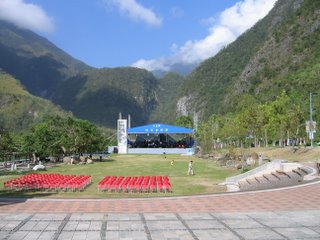
We decided to stop by the visitor center at the entrance to Taroko National Park. This is the beginning of the gorge if you are entering from the East, so you can still see the Pacific Ocean, but you are surrounded on all sides by steep mountains. There is an outdoor theater set up on the lawn adjacent to the visitor center. We all felt for a moment that we had just entered the Alps because they were having a concert there that morning. They had an orchestra and an opera singer playing classical music. I am no aficionado, but this really helped set the mood. I wish we could have stayed for a while, but with no daylight savings time in Taiwan, we needed to get on the trails ASAP.
I think we were all impressed from the beginning. It was an eerie feeling to know that we had just been on this road the night before, but had no idea what was around us. Some of us began snapping pictures from the car window. We pulled over a couple of times on our way to the first trail to snap more pictures. I think between the seven of us we must have taken nearly 1,000 pictures that day.
The first trail – the Tunnel of Nine Turns Trail – was impressive. This trail used to be part of the highway. The government carved a tunnel and moved the highway so tourists can come enjoy the scenery. It was carved along the side of the bluff overlooking the Liwu River and gorgeous marble cliffs. It's a short trail (about 1.9 km or 1.2 miles), so it didn't take us too long to finish and head for the next spot.
We stopped by the Hsiangte Temple in Tiansiang next. There is a hotel and some small tourist shops and restaurants here, so we thought it would be an ideal place for a break. Adi bought a sausage on a stick from the vendor next to the hotel, but decided he didn't like it about halfway through so he gave it to a stray dog that was hanging out next to the stand (hmm… how convenient!). This dog didn't look nearly as malnourished or neglected as the one at the 7-11 the night before. This one also seemed to have a more sociable attitude. After receiving payment, the dog decided to be our guide to the temple, following us over two bridges and up numerous stairs. She even waited for Steve, Ronny, and me as we climbed to the top of the pagoda!


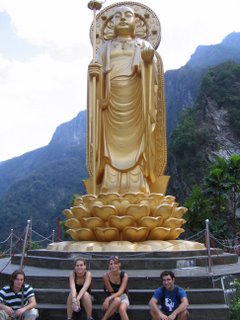 The Hsiangte Temple holds the world record for having the highest statue of the Ksitigarbha Bodhisattva, whatever that means. The were proud enough of the fact to display it prominently on a sign, so we thought it might mean something to someone. Anyway, after climbing to the top of the pagoda, Ronny, Steve, and I joined the others on the main grounds of the temple. The temple and Buddha statue were nice, but the surroundings were what really made this a memorable spot. We took lots of pictures and had a short rest before heading back down the way we came.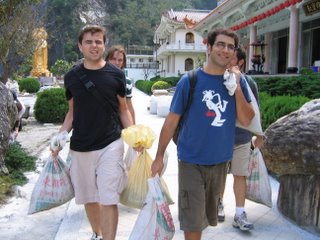
On the way down, a female monk shouted out to us and waved us over to her. Although we couldn't understand what she was saying, we figured out from her gestures that she wanted us to grab some bags of dry cement and haul them downhill to a spot where they were doing some kind of construction. A strange request, we thought, but how can you pass up a chance for some good karma? We each grabbed two bags and proceeded to march down the hill singing workers’ chants. I sang a poor rendition of “Sixteen Tons” followed by our whole group singing “Day Oh”. I think Stephanie got some video of this, which I am curious to see.
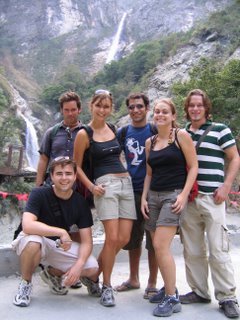
We then drove to our next trail – the Baiyang Waterfalls Trail. This trail has also been well-developed and is easily conquered, but unfortunately the last 400 meters or so is still closed from last month's typhoon. This trail offers more spectacular scenery and, at the end of the section that is still open, a good view of several tall waterfalls. Once again, many pictures were taken.
We were all pretty famished by this point, so we stopped again in Tiansiang for a bite to eat. The food here is very bland, overpriced Chinese food – but at least overpriced Chinese food translates to just over $2 U.S. for a meal. We then piled into the car again for our final hike – the Lyushui-Heliu Trail. This trail is very narrow in places and is pretty popular, so it can be a bit aggravating to have to pass people coming the other way when you barely have enough room to get by yourself. Fortunately, there are guard rails in the narrow spots and it isn't too long. Of course there was more great scenery from this trail and a small suspension bridge that some of our group really seemed to enjoy jumping up and down on. Ahh… The maturity of college students studying abroad…
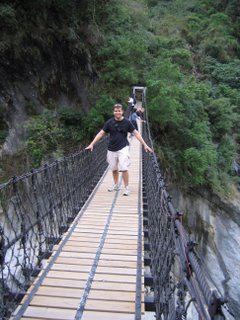
The trail ends on the Cross Island Highway. Steve, Ronny, and I walked along the highway downhill while Stephanie, Marjorie, Neils, and Adi went up to get the car. We met up at the Yuehwang Pavilion a little ways down the road. This pavilion sits near the entrance to a very long suspension bridge that spans a deep canyon over the river. I felt a bit like Indiana Jones crossing this one, though there were no poison-tip arrows flying towards me. Another trail starts on the other side of this bridge, which we decided to try at least part of the way. This trail was very different from any we had been on so far. It was steep, narrow, very rugged, and didn’t look like it had much traffic on it. After a few minutes most of our group decided to go back to the car, but Neils, Ronny, and I decided to push on a little farther. It was very narrow and steep – this is not a place you would want to slip. I thought about giving in, but a group of older people had passed us on their way down, so I knew it couldn't be completely impossible. We probably got about two-thirds up the mountain before we decided to stop. I think all of would have loved to go farther, but it was getting close to sunset and this is definitely not a trail you should try at night. I had been hiking all day, but this was the first time I had broken into a sweat, so it was kind of refreshing.
Marjorie took the wheel on the way back with Stephanie sitting in the front passenger seat. All of us guys in the back dozed off for a few minutes, something the girls seemed to find really amusing. Stephanie took pictures of each one of us sleeping. Yes, they were kind of funny, but I don't know how I feel about having a picture of me napping in a sweat-stained shirt. Slightly embarrassed, I guess…
We showered and relaxed at the hotel for an hour or two before heading off to Pizza Hut for dinner. I know this doesn't sound very interesting, but trust me – after as much Chinese food as we've had, some greasy pizza really hits the spot!
We went to a pub after dinner. We stopped in one that was playing the blues on CD quite loud, but nobody (except me) seemed to like the music, so we went across the street to a place with a live band. There were a decent number of young Taiwanese there, so we figured it would be an interesting place to hang out. We met some travelers from Spain, but they left very early. We were sitting behind the stage, so all of our ears were ringing after about 20 minutes, but we stayed for a while anyway.
About the time we decided we should go back to the hotel, some Taiwanese who were celebrating one of their friend's birthday came over to our table and drag us (literally!) out on the floor to dance with them. We played along for a while, but the covered music the band was playing was pretty lame (I mean, who plays a cover of Ricky Martin's “Living La Vida Loca” at a pub???), so we danced for a while, then returned to our seats.
The band seemed amused by the participation of the foreigners, so they joined the crowd in insisting we participate. This started to get annoying until everyone got in a circle and one of the Taiwanese guys told me we had to join in the next dance because it was “special”.
I only understood the word “friend” from the lead singer's introduction, but the music definitely caught my attention. It didn't sound too much like pop and it reminded me of Hawaiian music. Everyone lined up in a circle and held hands with the person two people away from them and started to dance in a circle. We had a hard time following, so we just watched the three or four guys who really looked like they knew what they were doing. As we were doing this, it hit us – we were right in the middle of a traditional Taiwanese aboriginal dance!
Taiwan has many aboriginal Polynesian tribes, but today they are few in number. Most of them live on the East Coast. We all really wanted to visit an aboriginal village to learn a little about them, but all we could find on the map and in our guidebooks seemed like extremely cheesy craft shows put on for tourists. We started to smile big because how better can you experience a culture than to be thrown directly into it on the spot? It was quite an experience. I don't remember how to do it and don't know much about what this dance is supposed to symbolize, but it was really fun. The lead singer later told me it was a dance of the Ami tribe and he said something about the ocean, but that's about all the information I could gather.
Well, I think this sets the record for my longest post ever. Thanks to all of you who made it this far (if anybody did). It was a long eventful day and I wanted to recall it in as much detail as possible while it's still reasonably fresh in my memory. I still have another day and a half of traveling to recount, but I might take a day or two off before I write those posts. I have been in the computer lab working on this for almost two hours now and I have a quiz in Chinese tomorrow that I need to study for. I hoped you enjoyed reading this and looking at the pictures more than I enjoyed sitting here for so long!
Until next time, take care!
Tuesday, November 01, 2005
East Coast Road Trip - Day One (The Scenic Route)
I had a wonderful long weekend, but unfortunately my busy study schedule over the next week and a half won’t allow me to sit down and write about it all in one shot. I will try to recall the events of the past four or five days in as much detail as I can, but it might be another four or five days before I can fill you in on all of it.
We went to the East Coast of Taiwan this weekend. This is the most rural area of Taiwan. It is full of beautiful mountains, valleys, rivers, and rugged coastline that are definite must-sees for any visitor to the “renegade province”.
On Friday, the car rental agency we used for our trip to Kenting came to the university to pick us up. Instead of taking us back to their office on the other side of Kaohsiung, they brought the forms with them and let us take the car straight from school. This saved us at least an hour, so I felt it would be better for us to take the central “Cross Island Highway” that the Lonely Planet guidebook for Taiwan has listed as an extremely scenic route.
The “scenic route” turned out to be quite interesting, but it's not very scenic at night. Unfortunately for my reputation as a travel planner, it turned out to be a much longer drive than the map indicated. Taiwan is a relatively small place, and the distance between Kaohsiung and our destination city of Hualien seemed to be about the same as the distance between Kaohsiung and Taipei. The Kaohsiung to Taipei trip only takes about five hours by bus, so it seemed logical (to me anyway) that it would take only a little longer to go via this highway. It took us approximately 12 hours in the car to get from school to our hotel… As much as I like road trips, this was a bit too much.
I thought we could make it to Sun Moon Lake in time to enjoy some of the sights before getting to the Cross Island "Highway". It started to get dark about the time we arrived, however, so we just passed by the lake and headed for the highway. We drove for probably an hour straight uphill when we saw some locals stopped on the road. We decided to take a break and Ronny, our German friend with the best Chinese ability among us, asked them how much farther Hualien was from where we were. Their answer – “If you want to go to Hualien from here, you have to walk!”
This was not the most encouraging news. These locals turned out to be very friendly and offered to help us get turned in the right direction. During our descent they stopped and one of the guys asked if he could ride with us part of the way so he could explain how to get there. From what little Chinese I can understand, however, I think his real motivation was curiosity. He asked Ronny a lot of questions about where we were from, what we were doing in Taiwan, and whether we liked it or not. He advised us to get gas before getting on the “highway”. We told him we still had just filled up two hours earlier and were still fine, but we took his advice anyway and got ready for what turned out to be a VERY long journey.
You may be asking yourself why I keep putting the word “highway” in quotation marks. Perhaps I am a little biased in my opinion as to what a highway ought to be, but I don't think this stretch of road deserves the title. “Winding narrow path of doom” might be a better name. Two-way traffic is allowed on this road, but in most places you have to pull over (if there is a place to do so) or pull to the edge of the road to let the other car squeeze by. There was not much traffic at all, but the traffic we did run into consisted almost entirely large trucks hauling construction equipment to stretches of road that were being worked on. We had to stop and get out of the way of some of the vehicles as their crews worked at night a few times as we made our way to Hualien. There is no lighting on the road, so you have to go slow because the turns are sharp and the drop off VERY steep. Many of the tunnels look like they had just been blasted recently, so it looked like you were driving through a natural cave. I suppose this was appropriate, considering it was Halloween weekend…
We learned later that some of the stretches of road we had been on were over 3,000 meters above sea level. That's almost two miles! We passed very few buildings and saw no towns for more than an hour! All of us were starving, but there really were no gas stations, restaurants, or convenience stores on the way. It seemed like we were on a very scenic road, but with no light, it was impossible to tell. The best we got was one scenic outlook on the top of one of the mountains where we stopped before we were too far from civilization. It could see the faint glow of light from a small town in the valley below. It was especially faint because we were higher than the thin clouds that blew in over the town! It was amazing to see so many stars, especially after living in Kaohsiung, where the humidity and pollution block out most sunsets, even on otherwise clear days. We saw a few shooting stars and breathed our first breaths of really cold air since coming to Taiwan. It was about 7 or 8 degrees outside (in the mid 40s for those using Fahrenheit) and we were wearing our normal attire for Taiwan – shorts or jeans, sneakers or flip-flops, and t-shirts! Brrr!!!
We finally made it to Hualien sometime after midnight. Famished, we stopped at the 7-11 to grab something to eat. We sat outside and gorged ourselves on reheated prepackaged Chinese food and enjoyed the warmer air of the lower elevation and the relief from being out of the car. A mangy stray dog watched us eat with pathetic eyes, so I couldn't help but toss her some of my friend rice. Adi seemed really touch by the poor condition of the mutt, so he went in and bought it a can of dog food. Hopefully it found more empathetic foreigners to beg from after we left.
Our hotel was pretty roomy and we were ready to sleep by the time we got there. All of us were exhausted and we had a big day of hiking planed for Saturday. When I get time tomorrow or the next day, I will tell you of our adventures in the Taroko Gorge – probably the most beautiful natural spot in Taiwan. If you can't wait, go ahead and check out the many, many pictures I have already loaded on my photo gallery. Until then!
We went to the East Coast of Taiwan this weekend. This is the most rural area of Taiwan. It is full of beautiful mountains, valleys, rivers, and rugged coastline that are definite must-sees for any visitor to the “renegade province”.
On Friday, the car rental agency we used for our trip to Kenting came to the university to pick us up. Instead of taking us back to their office on the other side of Kaohsiung, they brought the forms with them and let us take the car straight from school. This saved us at least an hour, so I felt it would be better for us to take the central “Cross Island Highway” that the Lonely Planet guidebook for Taiwan has listed as an extremely scenic route.
The “scenic route” turned out to be quite interesting, but it's not very scenic at night. Unfortunately for my reputation as a travel planner, it turned out to be a much longer drive than the map indicated. Taiwan is a relatively small place, and the distance between Kaohsiung and our destination city of Hualien seemed to be about the same as the distance between Kaohsiung and Taipei. The Kaohsiung to Taipei trip only takes about five hours by bus, so it seemed logical (to me anyway) that it would take only a little longer to go via this highway. It took us approximately 12 hours in the car to get from school to our hotel… As much as I like road trips, this was a bit too much.
I thought we could make it to Sun Moon Lake in time to enjoy some of the sights before getting to the Cross Island "Highway". It started to get dark about the time we arrived, however, so we just passed by the lake and headed for the highway. We drove for probably an hour straight uphill when we saw some locals stopped on the road. We decided to take a break and Ronny, our German friend with the best Chinese ability among us, asked them how much farther Hualien was from where we were. Their answer – “If you want to go to Hualien from here, you have to walk!”
This was not the most encouraging news. These locals turned out to be very friendly and offered to help us get turned in the right direction. During our descent they stopped and one of the guys asked if he could ride with us part of the way so he could explain how to get there. From what little Chinese I can understand, however, I think his real motivation was curiosity. He asked Ronny a lot of questions about where we were from, what we were doing in Taiwan, and whether we liked it or not. He advised us to get gas before getting on the “highway”. We told him we still had just filled up two hours earlier and were still fine, but we took his advice anyway and got ready for what turned out to be a VERY long journey.
You may be asking yourself why I keep putting the word “highway” in quotation marks. Perhaps I am a little biased in my opinion as to what a highway ought to be, but I don't think this stretch of road deserves the title. “Winding narrow path of doom” might be a better name. Two-way traffic is allowed on this road, but in most places you have to pull over (if there is a place to do so) or pull to the edge of the road to let the other car squeeze by. There was not much traffic at all, but the traffic we did run into consisted almost entirely large trucks hauling construction equipment to stretches of road that were being worked on. We had to stop and get out of the way of some of the vehicles as their crews worked at night a few times as we made our way to Hualien. There is no lighting on the road, so you have to go slow because the turns are sharp and the drop off VERY steep. Many of the tunnels look like they had just been blasted recently, so it looked like you were driving through a natural cave. I suppose this was appropriate, considering it was Halloween weekend…
We learned later that some of the stretches of road we had been on were over 3,000 meters above sea level. That's almost two miles! We passed very few buildings and saw no towns for more than an hour! All of us were starving, but there really were no gas stations, restaurants, or convenience stores on the way. It seemed like we were on a very scenic road, but with no light, it was impossible to tell. The best we got was one scenic outlook on the top of one of the mountains where we stopped before we were too far from civilization. It could see the faint glow of light from a small town in the valley below. It was especially faint because we were higher than the thin clouds that blew in over the town! It was amazing to see so many stars, especially after living in Kaohsiung, where the humidity and pollution block out most sunsets, even on otherwise clear days. We saw a few shooting stars and breathed our first breaths of really cold air since coming to Taiwan. It was about 7 or 8 degrees outside (in the mid 40s for those using Fahrenheit) and we were wearing our normal attire for Taiwan – shorts or jeans, sneakers or flip-flops, and t-shirts! Brrr!!!
We finally made it to Hualien sometime after midnight. Famished, we stopped at the 7-11 to grab something to eat. We sat outside and gorged ourselves on reheated prepackaged Chinese food and enjoyed the warmer air of the lower elevation and the relief from being out of the car. A mangy stray dog watched us eat with pathetic eyes, so I couldn't help but toss her some of my friend rice. Adi seemed really touch by the poor condition of the mutt, so he went in and bought it a can of dog food. Hopefully it found more empathetic foreigners to beg from after we left.
Our hotel was pretty roomy and we were ready to sleep by the time we got there. All of us were exhausted and we had a big day of hiking planed for Saturday. When I get time tomorrow or the next day, I will tell you of our adventures in the Taroko Gorge – probably the most beautiful natural spot in Taiwan. If you can't wait, go ahead and check out the many, many pictures I have already loaded on my photo gallery. Until then!
Tuesday, October 25, 2005
Just a small burglary
Sorry it's been so long since I've posted, but not much has been happening recently. The biggest news I have is that my wallet was stolen last weekend. Originally I thought I had misplaced it, but the day after I noticed it was gone one of the other international students told me he and several other students had their wallets taken from their room while they slept the same night that mine disappeared. I normally lock the door before I go to bed, but I guess I forgot that night (last Saturday). The scary thing is that the thief was in my room while I and both of my roommates were there. I didn't lose that much cash and they didn't charge anything on my credit cards, but it was a real annoyance. My credit and bank cards are easily replaceable, but my driver's license cannot be replaced until I go back to the U.S. in December.
I spent part of the week dealing with the administration and trying to find out what they are doing to improve our security and catch the culprits. They responded by fixing some of the broken locks on some of the doors in our building and putting up signs encouraging students to keep the emergency exits closed. These doors have no security cameras and some students had been leaving them propped open 24 hours a day until now. Since there still aren't security cameras on all the doors and the windows on the first floor are always open, I don't really feel much safer. My roommates and I have decided to keep our door locked at all times, even when we are home, just in case. I am also taking more precautions to make sure my valuables (not that I have too many) aren't in plain sight.
I talked to one of my professors in the U.S. about this problem and he helped put things in perspective. This kind of thing can happen anywhere in the world and if I was going to have things stolen from me, it's better it happened this way than through some violent mugging a la the American streets. It was really more of an annoyance than a serious loss and I didn't get hurt. Two of the Taiwanese students had all of their money withdrawn from their bank accounts by the thieves, so I am also lucky that they didn't even try mine. My guess is the thieves don't speak English very well and probably just threw away my wallet after taking the small cash in it.
Other than this incident, things have been going pretty well. My trip to Yushan (the highest mountain in Taiwan) was put off until late November and I'm going to the East Coast of Taiwan this weekend. I have been trying to keep up on all my studying, which has been pretty challenging. I aced my first Chinese quiz, but we have our second tomorrow, which will probably be much more difficult. I have two big presentations to prepare for, and I am trying to get all my work done on those in the next two and a half weeks - before I go to Italy! I can't believe it's coming up so soon!
I'm very excited for this trip - my first trip to Europe and my first chance to see Maiko since August! I bought guidebooks to Florence and Rome (the two cities we are spending most of our time in) about a month ago. I try to read from them for at least 30 minutes a night, but that hasn't always been possible with my schedule. It's a long trip from Kaohsiung to Florence, so hopefully I can catch up on my Italian background reading on the 30+ hours it will take me to get from Kaohsiung to Florence. I'm flying from Kaohsiung to Taipei, then Taipei to Bangkok, then Bangkok to Amsterdam, then Amsterdam to Rome, then I have to take a train from Rome to Florence. It's one of the longest trips I have ever taken, but I'm sure it will be worth it! I have decided to try not to put on any weight before I go because I want to gain all my winter weight ("insulation") while I'm in Italy.
That's all for now. I'll be sure to post about my East Coast trip next week.
I spent part of the week dealing with the administration and trying to find out what they are doing to improve our security and catch the culprits. They responded by fixing some of the broken locks on some of the doors in our building and putting up signs encouraging students to keep the emergency exits closed. These doors have no security cameras and some students had been leaving them propped open 24 hours a day until now. Since there still aren't security cameras on all the doors and the windows on the first floor are always open, I don't really feel much safer. My roommates and I have decided to keep our door locked at all times, even when we are home, just in case. I am also taking more precautions to make sure my valuables (not that I have too many) aren't in plain sight.
I talked to one of my professors in the U.S. about this problem and he helped put things in perspective. This kind of thing can happen anywhere in the world and if I was going to have things stolen from me, it's better it happened this way than through some violent mugging a la the American streets. It was really more of an annoyance than a serious loss and I didn't get hurt. Two of the Taiwanese students had all of their money withdrawn from their bank accounts by the thieves, so I am also lucky that they didn't even try mine. My guess is the thieves don't speak English very well and probably just threw away my wallet after taking the small cash in it.
Other than this incident, things have been going pretty well. My trip to Yushan (the highest mountain in Taiwan) was put off until late November and I'm going to the East Coast of Taiwan this weekend. I have been trying to keep up on all my studying, which has been pretty challenging. I aced my first Chinese quiz, but we have our second tomorrow, which will probably be much more difficult. I have two big presentations to prepare for, and I am trying to get all my work done on those in the next two and a half weeks - before I go to Italy! I can't believe it's coming up so soon!
I'm very excited for this trip - my first trip to Europe and my first chance to see Maiko since August! I bought guidebooks to Florence and Rome (the two cities we are spending most of our time in) about a month ago. I try to read from them for at least 30 minutes a night, but that hasn't always been possible with my schedule. It's a long trip from Kaohsiung to Florence, so hopefully I can catch up on my Italian background reading on the 30+ hours it will take me to get from Kaohsiung to Florence. I'm flying from Kaohsiung to Taipei, then Taipei to Bangkok, then Bangkok to Amsterdam, then Amsterdam to Rome, then I have to take a train from Rome to Florence. It's one of the longest trips I have ever taken, but I'm sure it will be worth it! I have decided to try not to put on any weight before I go because I want to gain all my winter weight ("insulation") while I'm in Italy.
That's all for now. I'll be sure to post about my East Coast trip next week.
Sunday, October 16, 2005
The Holy Rosary Cathedral Minor Basilica
I had seen this church from the bus window many times and it always stands out. The basic scenery of urban Kaohsiung consists of old-run down buildings that sometimes look like they have been bombed out and brand-new, clean, modern retail stores, restaurants, and other places of commerce. The church lies between some of the tightly-packed, dirty, run-down buildings on Wufu Road. It is set back a little from the street and has some open space between it and the surrounding small buildings (also administered by the church). It may not be the biggest church I have ever seen, but it isn't tiny, either. The neon lining the crucifix at the top really stands out at night, and the architecture is very western.
The sign on the fence out front lists the mass times. This church has mass in Taiwanese, Mandarin Chinese, and English. English mass is only held once on Sundays, but thankfully it isn't too early (11:00 am). As I was writing a note to myself to come back on Sunday (this was during my Friday night walk), I noticed a light on in the guard booth by the front gate. I asked the older gentleman sitting in there if he spoke English and if he could give me some information about the church. He spoke English with a little difficulty, so I tried Japanese. To my amazement, (he didn't look quite old enough to have had much of a Japanese education) he spoke excellent Japanese. He insisted on taking me inside to show me the church even though it was dark and I told him I would be back on Sunday.
My first impression of the inside of the church was – “Wow, am I in Mexico?” It turns out that the church was built in 1859 by the Spanish and has the image of Santa Maria displayed prominently in the altar. I am not good at describing art or religious iconography, but I took many pictures, so when flickr is working again, check them out. It is very colorful and with the exception of a few characters written inside the church, it doesn't give you any sense that you are in Asia.
I went back today for mass. The church was packed with a very international group, mostly laborers from the Philippines. Father Renaldo is also from the Philippines, but unlike Catholic services in Japan, there were some other nationalities represented as well. One of the members who did some of the readings is even from St. Louis! I also met a couple from India and I believe there are many Thai laborers that attend, as well.
During the service, Father Renaldo asked us to say a prayer for migrant workers everywhere. This statement is especially poignant in Kaohsiung. The subway system currently under construction is being built by foreign laborers, primarily from Thailand. Shortly before I arrived, they apparently rioted and went on strike because they have not been treated altogether fairly. At first I had heard that they rioted because their bosses would not let them drink, smoke, or gamble in their dormitories, but according to a few other locals, they have been taken advantage of in several other ways. A law enforcement officer I met this weekend told me that the company who contracts these workers does not pay them with real money! They are give “credit” that they have to use at company-owned store (who hears that old song “Sixteen Tons”?) and is not valid elsewhere. Someone here on campus (whose knowledge on this subject I trust very much) told me that the contracting company was supposed to be paying them about $1,000 U.S. a month in salary, but they were only receiving about a third to half of that. Even $1,000 might not seem like much to most Americans, you could easily live off of that here and still be able to save some or send some home to your family if you lived “on the cheap”.
Keeping these issues in mind, I readily offered my prayers for these hard-working people and their families.
After the service, I hung around to speak with Father Renaldo and some of the churchgoers. They let me snap some pictures (again, once flickr is working I will load them) and even fed me! I hung around and chatted with some of the Philippinos for a while as they gave me some noodles, bread, and cake. My stomach was still a little unsettled from the Pizza Hut buffet, but I managed to get enough down for a small lunch.
I really like this church and the congregation. I am sure I will be back on the few Sundays when I will actually be here in Kaohsiung, but I have a lot of travel plans coming up, so that will probably only be about half of the Sundays between now and Christmas. Hopefully I can make it to the Christmas party they invited me to, because I am sure there will be some free food there!
Subscribe to:
Posts (Atom)